


VIII. The Bathroom
Description
This section is from the book "Home Furnishing, Practical And Artistic", by Alice M. Kellogg. Also available from Amazon: Home Furnishings, Practical And Artistic.
VIII. The Bathroom
The Order of the Bath, as a military honour, was instituted by King George I in 1725; the earlier Order of this name, however, dates back to 1399, when the knights who received it were really treated to a bath as a token of their regeneration.
We are so accustomed nowadays to the facilities for personal cleanliness that the pomp and ceremony of King Henry IV's Order seems absurd. Yet the perfection of our present-day plumbing and bathroom appurtenances has been attained only by degrees, each year recording still further improvements.
The bathroom equipment, while recognised as an important factor in preserving the family's health, does not arouse as much interest as it deserves. When expense is not considered, a bathroom may have as outfit that is the perfection of exquisite style. In homes of more moderate cost the aim should be to have fewer. If any, of the luxuries, but of the necessaries the very best.
In addition to the long bathtub so generally seen, there are extra tubs made for the shower bath, sitting bath and foot bath, besides an arrangement for a shampoo bath that consists of an attachment that fits over the long tub.
The lavatory in the highest class of plumbing is made in one piece of iron and enamelled to prevent the lodgement of dust or germs that carry disease. While the lavatory would seem to offer little opportunity for variety of design, there is, nevertheless, quite a number of round, oval, square and oblong patterns made. One of the latest, interesting from a sanitary and artistic point, is in marked contrast to the older forms and is cast in two pieces which are joined and then enamelled, making an absolutely unbroken surface. For a very compact bathroom, with the usual fittings of tub, washstand and toilet, there is an adjustable seat to attach to the tub for a foot bath. This may be taken away when not in use.
The shower bath has been until quite recently a luxury reserved for those who could build it into their own houses. A new portable shower bath enables even the temporary resident of a rented house, or a summer or winter boarder, to own his own personal apparatus and carry it around with him. The curtain is made of soft white rubber that folds back when not in use. The frame is of nickel-plated tubing, requiring only two nails or screws driven into the wall for its adjustment.
The floors of a bathroom should not be carpeted. If the wood is not right for a partial covering with a mat or rug, the entire surface may be covered with oilcloth, inlaid linoleum, or rubber tiling; or a thin wood carpet may be laid over the old one. In building a new bathroom a tiled floor is better than wood.
Some special rugs are made up for the bathroom in wool, having a mottled centre with a border of the same colours used in the centre - blue-and-white, green-and-white or red-and-white.
Cheaper ones are manufactured in cotton, and sometimes a Turkish towelling is laid on the floor for each bather. Japanese jute rugs have been bought for the bathroom on account of their small cost, but the harsh material proves unpleasant to the feet. The revived interest in rag-carpet weaving has brought out some of the old-fashioned hit-or-miss patterns in good colours that are suited to the floor of the bathroom. These are satisfying to the aesthetic taste when the colours respond to the tones of the woodwork. Another recommendation is their ability to stand laundering.
Bathroom walls, in the better grade of houses, have a wainscot five or five-and-a-half feet high of wood or tile. Sometimes a white cement is marked off in four-inch squares to give the appearance of tiles. The wall space above is then painted or papered, the first being the more durable and sanitary finish. If decoration is desired on the plain wall, a stencil border in darker tints may be applied. If the regular varnished bathroom paper is adopted, its ground work should correspond with the colour of the woodwork; that is, a cream-white paper will look better with cream-white woodwork than one or the other of a blue-white with cream-white in conjunction.
A bathroom entirely in white, in the ivory tone, is the favourite treatment for the ideal home. A touch of colour may appear at the top of the wainscot in a line of blue, yellow, pink or green tiling, and the rug may repeat the same colour in larger quantities. By keeping to one colour in the limited sphere of the bathroom a better result is achieved than with a mixture of two or three colours. Blue is generally chosen for the bathroom, but other colours will blend as well with white paint.
The older styles of bathroom papers have the tiled patterns familiar to us all, but some new imported papers have flowered designs, windmill scenes, sea-gulls flying over deep seas and pond-lilies on still waters. Sometimes a bathroom of good size is treated as a dressing room, and if the walls are covered with the same paper that is put on the walls of the sleeping room a transparent varnish will be needed to protect the dressing room walls from the dampness.
The regular linen closet should be separate from the bathroom, but a small closet for the especial linen of the bathroom may be introduced into the walls or fastened in a corner. A medicine closet is sometimes sunk into the wall of a bathroom and the door fitted with a mirror. A washstand in a bathroom may have a centre mirror and one at each side, placed in a slanting position to afford assistance in dressing the hair.
Nickel-plated bars are made for hanging towels in the bathroom, and there are also straight rests for laying down towels in a quantity. Baskets of nickel plate are also made to receive soiled linen. In selecting towelling for the bathroom the larger sizes are not apt to be overlooked, but it is advisable also to have an abundance of small-sized towels for handwashing that may be used once and discarded.
In curtaining a bathroom window two curtains should be made up, so that a fresh one may always be on hand. White muslin of a sheer, dainty pattern may be chosen, or a plain hemstitched linen. If leaded glass can be afforded for this room a plain colour, clear or opaque as preferred, will make a more refined interior than the garish coloured glass usually specified for a bathroom.
Besides the stationary belongings of the bathroom - tubs, shower bath, lavatory, and closet - there should be in the complete outfit for this room a soap-dish, sponge-holder, soiled-linen basket, tumbler-holder, robe-hook, match-box and toilet-paper holder. Each one of these articles should be kept in order with exactness and regularity, receiving, before any other room in the home, daily care. Plenty of soap and water should be given the enamelled work, with occasional additions of ammonia. The nickel plating may be rubbed with a soft, dry cloth, only whiting being used as a polisher. Patent prescriptions for nickel plate should be avoided, as they often contain an acid that destroys the metal.
Sanitary plumbing is of so great importance that in building a house every item that makes for show should be cut out if it in any way deprives the bathroom of the best class of work. Cases of illness are certain to follow careless plumbing, with doctors' bills that soon show the false economy.
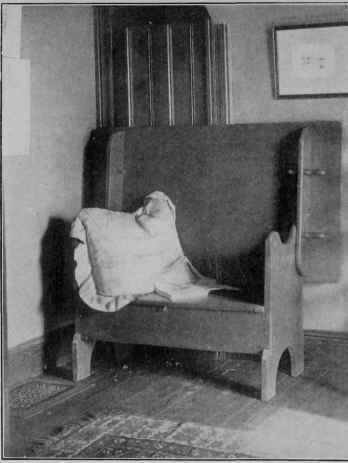
A SETTLE-TABLE.
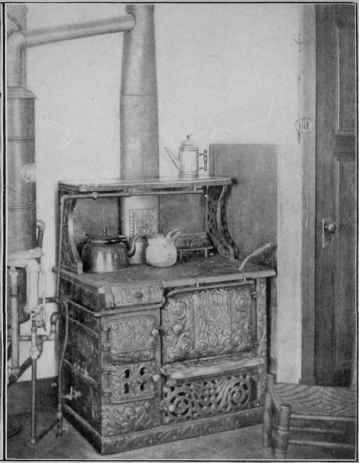
A COMBINATION GAS AND COAL RANGE.
Continue to:


My Books

