


IX. The Kitchen And The Housemaid's Room
Description
This section is from the book "Home Furnishing, Practical And Artistic", by Alice M. Kellogg. Also available from Amazon: Home Furnishings, Practical And Artistic.
IX. The Kitchen And The Housemaid's Room
A GOOD word has been spoken for the kitchen by one who has given inspiration to all departments of the house - William Morris. "In a country farm-house," he says, "the kitchen is commonly pleasant and homelike, the parlour dreary and useless."
Few kitchens in our own country can claim these attributes, as taste in this part of the home is not often combined with a practical equipment.
The requirements for cooking are naturally of first importance, and whatever economy must regulate other details, the stove or range should be one that is absolutely reliable. A gas stove in small apartments frequently takes the place of one that consumes coal, and in kitchens of ample size one of each kind is often installed. A combination gas and coal range is also in use, with a hot-water boiler attached for whichever medium is preferred.
To carry off cooking odours two expedients may be turned to in the kitchen: an iron hood over the range, or a register in the chimney. Rapid ventilation from the windows is, of course, essential, and this may be accomplished if the windows are placed on opposite sides of the room and close to the ceiling. The lowering of the upper and raising of the lower sash will then perform most satisfactorily the purifying of the atmosphere.
The window shade in the kitchen, to be most helpful, may be a double fixture fastened at the middle of the casement and adjusted upward or below from that point.
Window curtains add a trim appearance to the kitchen, and if properly selected and hung they are not at all inappropriate. Some of the goods sold for summer wash dresses - percale, dimity, gingham or muslin - in pretty colour combinations offer suggestions for kitchen service. They should be hung only to the sill and sewed to small brass rings and slipped over a tiny brass rod that is screwed to the top of the casement.
Oilcloth is generally in favour as a floor covering for the kitchen floor, but the heavy inlaid linoleum, although higher in price, repays for the outlay by its long wear. The rubber interlocking tiles are also used on kitchen floors in more expensive dwellings. As a provision of comfort for the worker in the kitchen a small rug should be laid before the sink, wash-tubs or table, where there is much standing.
The walls of the kitchen are mainly responsible for the general aspect, whether it be light and bright, or dingy, dismal and repellent. Unless this room is flooded with sunshine the colour of the walls may be of cream-white, yellow or buff. In city basements where sunshine is never present, both walls and woodwork are finished in pure white paint that can be washed easily. A whitewashed wall may be kept sweet and clean with a semi-annual renewing. Oil paints, laid on in three welldried coats, make a serviceable surface. If the walls are not in condition to paint, they may be first covered with a plain or lining burlap and then painted with oil colours. A new wall covering for kitchens and pantries is made in a thin oilcloth in soft shades and good patterns with a glazed or a dull finish.
A kitchen wall that is tiled from floor to ceiling is an impossible luxury for the home of moderate cost, and even a tiled wainscot may be prohibited by the expense, but the space above a sink may be fitted with tiles at no very great expenditure.
Placing a sink in front of a window is a help in making the routine work of washing pans and kettles less like drudgery. To secure an architectural effect for the exterior of a house, this arrangement of an outlook is often thought lessly taken away from the kitchen.
The secret of making kitchen work enjoyable is to keep recurring duties at a minimum and relieve them by every labour-saving device. In one home the drying of plates and platters was accomplished by draining the dishes in a rack that was built above the sink.
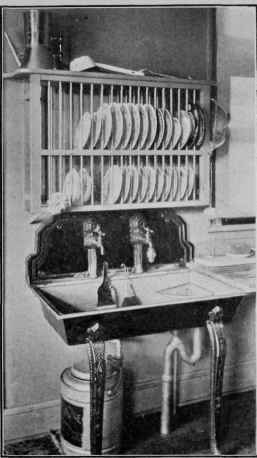
A RACK FOR DRYING DISHES.
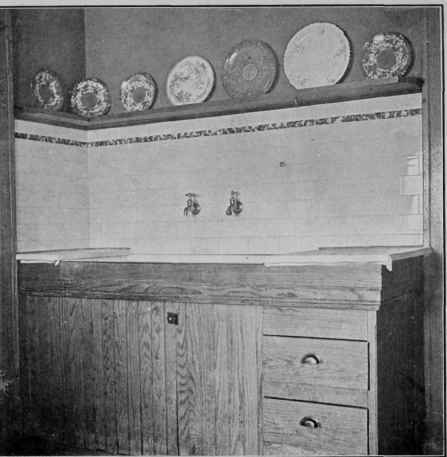
TILING OVER THE SINK.
The saving of steps and time is another important consideration that is little appreciated, unless the mistress of the home undertakes the kitchen work herself. Then the mistakes in arrangement and lack of conveniences become understood. The sink may be too far from the range; the table may be at the wrong side of the room; the doors may open on the wrong side of the wall; windows may be too far from the floor or too low down. The permanent errors of building must, unfortunately, be endured, but many of the petty annoyances in kitchen fittings may be overcome by the exercise of a little ingenuity.
A butler's pantry as a connecting link between the kitchen and dining room is considered essential in the modern home. When fitted with a sink and hot and cold water, shelves, cupboard and drawers, this pantry relieves the kitchen of dishes, silver, linen and food supplies. A closet at one end of the butler's pantry, in which extra stores may be kept under lock and key, is sometimes introduced.
A well-lighted pantry, opening from the kitchen, may be reserved for materials for baking and for preparing the food that is to be cooked. Closets for pots and kettles may be built into the wall if the kitchen is small, and further space gained by having sliding doors. A display of clean enamelled ware on the kitchen walls is not at all an objectionable feature, but pots and kettles may be kept out of sight in their own closet.
The refrigerator in a model kitchen is placed in a closet opening on the porch, where it may be filled with ice without entering the room.
Inadequate lighting of the kitchen at night is a common fault, yet in no other part of the house is there so much need of attention to this detail.
A laundry is usually provided near the kitchen or in the cellar, and sometimes a space in the attic is portioned off for drying clothes in inclement weather. In houses of recent designing a chute is installed from the upper floors to the laundry for sending down soiled clothing.
If a latticed porch is attached to the kitchen, some of the preparations for meals may be made away from the heat of the stove during the hot weather, and the enclosure will also serve as a sitting-place on warm evenings.
The allotment of expense for furnishing the home should include comfortable and orderly fittings for the housemaid's room. It is false economy to pass on to this room from other parts of the house articles that are of alien character and unsuited to the conditions.
If one room must be occupied by two persons, there may be a separate bed, washstand and bureau for each. Sanitary and durable furniture, soundly constructed, should be chosen. If the woodwork and furniture are painted alike in an enamelled tint, the room at once takes on a look of harmony. A painted wall will look harsh and cold if it is not soft and pleasing in tone. On the north side of the house a light red or buff may be chosen; on the southern exposure a French gray, pale green or turquoise blue. The addition of a stencilled border in a cream colour or a deeper shade of the wall colour around the doors and windows and under the ceiling will contribute a touch of decoration in a simple, attractive way. If a narrow picture moulding is fixed to the wall within arm's reach it will facilitate the changing and hanging of pictures by the inmate of the room without marring the walls. If pictures are kept permanently on the walls a choice may be made in the coloured prints expressive of action - stage-coach days and hunting scenes, some of them with humorous motives. The opportunity for adding some personal contributions to the walls is seldom given, but always enjoyed.
The homelike feeling that draperies at the windows impart need not be forgotten nor set aside from over-strict motives of ventilation, as the manner of making and hanging will accomplish both artistic and practical aims. Wash muslins for dress use in small-flowered designs are a dainty, uncostly selection for the housemaid's windows.
The rugs for the floor may fit the spaces beside the bed and in front of the bureau and washstand in sizes not too large for easy cleaning and in colours neither dark nor light. A mixture of wood browns is a safe choice for almost any colour scheme employed in this room, and the small Scotch rugs are appropriate for this use.
A bathroom for the housemaid is no remarkable luxury in houses of late construction, but if the washing arrangements are kept in the bedroom they may be chosen for their neat style. To be able to replace broken pieces without mismatching them, it is wiser to buy from an open stock of toilet ware.
While every effort to make the interior of the housemaid's room attractive and comfortable is being made, its exposure will be most potent in assisting or defeating the results. A south room will do the most in giving a wholesome atmosphere, both in summer and winter.
When a sitting room or servants' hall is provided on the first floor it is often used at meal times. A table in the centre will serve for dining and evening use. A rug may cover the floor in the winter and be removed in the summer. The windows may have muslin or chintz curtains to the sill, and the walls may be papered, painted in oil or tinted with water colours. Comfortable rockers, some side and arm chairs with cane seats, hanging shelves for books and small articles and a few pictures may complete the fittings of this room. Freedom in rearranging the furnishings will add to the pleasure of the inmates and give something of the feeling of ownership.
If it is impossible to provide a room of this kind, a laundry that is near the kitchen may be converted into quite a good substitute on other days than those devoted to washing and ironing, by installing chairs, tables and a good reading light.
Continue to:


My Books

