


Lesson III. Final List Of Visible Letters
Description
This section is from the book "Haven's Complete Manual Of Practical Phonography", by Curtis Haven.
Lesson III. Final List Of Visible Letters
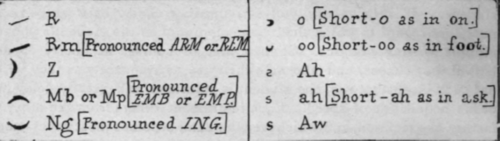
In above final list are presented ten signs - the concluding letters of the Visible Alphabet of Haven's Practical Phonography - the last five - short-o, short-oo, Ah, short-ah and Aw - being vowels; the others, consonants. The three letters requiring particular pronunciation are Rm, Mb or Mp and Ng, which must always be learned and referred to as Arm, Emb or Emp and Ing, the signs represented by the small letters o, oo and ah, being called short-o, short-oo and short-ah.
R and Arm are always written upwards and at a slant just midway between Chay and K; Emb is a thickened M; Ing a thickened N; Z like a thickened S; short-o is the O of last lesson bowed, or like a shaded Whay; short-oo is the Oo of last lesson bowed, or like a shaded U; Ah is a waved line resembling the juncture of the letters Whay and Way in that order, while short-ah and Aw are waved lines similarly resembling the juncture of Way and Whay, Aw being shaded in center.
R, Arm, Z, Emb and Ing are written the same size as the letters illustrated in Lesson I; the other letters of this list are written the size of the small letters of Lesson II (Timely Suggestions), that is, one-eighth the size of the large ones. The letter R is, of course, placed above, on or through the line of writing to represent I, A or U invisibly, as in signs 1, 2, 3, in Exercise. To clearly illustrate the exact slant of R and Arm, the author presents those letters below grouped with Chay, K, etc.

By always writing R and Arm upwards and Chay and J downwards, the difference in slant between those letters is easily maintained.
To better exhibit the similarity to each other, as well as the individual differences between the outline of each character given in preceding alphabetical lists, the author herewith appends:
Continue to:


My Books

