


The Complete Visible Alphabet
Description
This section is from the book "Haven's Complete Manual Of Practical Phonography", by Curtis Haven.
The Complete Visible Alphabet

P
B
T
D
Tchay
J
R
Arm. or Rem
K
Gay
F
V
Ith or Thee
S
Z
Ish or Zhee
L
M
Emb or Emp
N lug

I
Oi
A
Hay
Ow
Ai or &
Oo
Short-i
Short - a
Way
Hway
Short - o
Short - e
E
Yay or Short-u
U
Short-oo
Ah
Short -ah Aw
The above Complete Visible Alphabet of Practical Phonography is composed of twenty-one large letters, about three-sixteenths of an inch in length, and twenty-one small characters, made about one-eight the size of the large ones. Twenty-four of these letters are called consonants and eighteen vowels. All the large letters and the small ones Hay, Way and Whay are the consonant letters, the remainder of the small letters being the vowels.
Now, for further successful progress in these lessons, it is especially-necessary that every sign of the Visible Alphabet be so thoroughly familiar to the eye of the student that any of those signs be known when not presented in the ordinary order of their arrangement, and hence, for memorizing, they are illustrated in comparative form below:
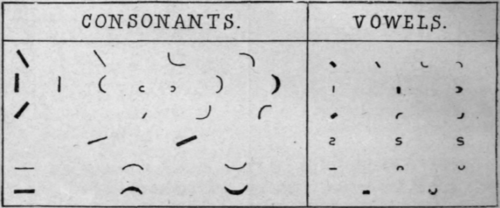
Students should practice memorizing the alphabet until the letters in foregoing schedule can be read with considerable facility, both from left to right and right to left, before attempting to learn further exercises. Such memorizing will not only give a thorough acquaintance with the names of the signs of the Visible Alphabet, but the separation of the vowels and consonants, as in the schedule, will also serve to impress upon the mind which signs are consonants and which visible vowels.
The use of the vowel signs in spelling personal names is shown in signs 4 to 20 in Exercise, though all spelling, even in personal names, should be done phonetically, viz: R, long-I and T, as in sign 4 in Exercise, spells the personal name of Wright, etc., etc., because even in writing personal names, all that is necessary is to write sounds, for, in speaking Mr. Wright's name, we would simply utter the sounds of R, long-I and T, and hence we need no more representation in phonography, but we generally write the vowel sign in personal names instead of indicating it invisibly, for reasons which will be explained in a future lesson, though in spelling the common words, right or write, we would have indicated the vowel sound by position.
The numeral eight is spelled ai-t, as in sentence in sign 45.
The proper place for all outlines which do not indicate invisible vowels is on the line of writing, hence, all the proper names of signs 4 tc 20 in the Exercise are commenced or rest on the line. It is only when vowels are indicated invisibly that outlines are commenced above, through or beneath the line, and even then it is only the first consonant which takes position, other consonants taking whatever position is convenient at the time, as with signs 27 and 33 in Exercise, wherein the second written letter is written out of position simply because the first consonant must have position, and both cannot.
It will doubtless be no little satisfaction to the beginner, however he or she may love study, to know that with this lesson terminates all visible alphabetical memorizing, enough means having now been presented to represent, phonographically, any sound of the English language. The elements of phonography being now within the grasp of the learner, future lessons will be entirely taken up with interesting contractions and practical application of the system.
Continue to:


My Books

