


The St And Str Loops
Description
This section is from the book "Haven's Complete Manual Of Practical Phonography", by Curtis Haven.
The St And Str Loops
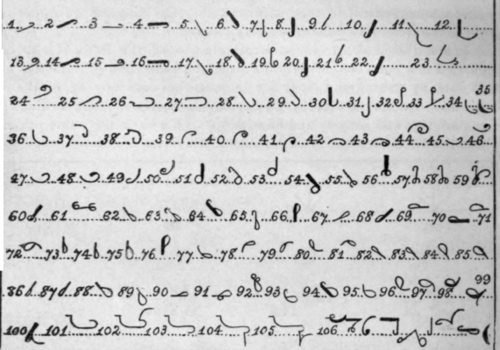
A narrow loop, half the length of a full sized consonant and written on the same side of consonant as the circle S or Z is written upon, represents the addition of St or Sd to the main consonant. Signs 62 to 70.
A larger loop adds Str. Signs 71, 72, 75, 76, 84, etc.
When these loops are added on the R hook side of P, B, etc., the P or B become double consonants, just as though the R hook was actually there, the P or B being pronounced Per, Ber, etc., as the case may be, the St or Str loop being read first, as in signs 83 and 85 ( St-per, Str-per) stopper, stropper. A comparison of sign 82 with sign 83 and sign 84 with sign 85 will show their difference of outline and individual significance. See also below diagram:
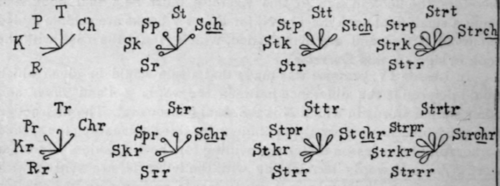
Young students in this art of winged words sometimes are at a loss to understand why phonographers indicate the addition of R to St, by writing St on the R side of P, B, etc., when, as they think, that unnecessary trouble might be obviated by the use of the Str loop, which contains R without special assignment of position. The reason this question is very generally asked is because a student does not always immediately grasp the particular use of, and difference between those combinations. ' Let us look carefully at the two signs 83 and 84. Truly the loop of both signs indicate the same consonants. But let us investigate farther. Let us take the entire word of each sign. The first is stopper, the other strop. Now analyze them phonographically, leaving out vowels and repeated consonants, and we find their outlines to be - sign 83, st-pr; sign 84, str-p. Looking at these analyses, we discover that the R in sign 84 precedes the letter P, while in sign 83 it follows the P. This, then, is the sole secret of their difference in outline. You could not spell stopper by writing an Str loop on the right hand side of letter P, because loops on that side are read before the letter to which they are joined, and you could not spell strop by writing the St loop on the R hook side of P, because in such instance where an R is indicated only in that manner, the R is read after the P. The diagram on opposite page illustrates these differences very clearly:
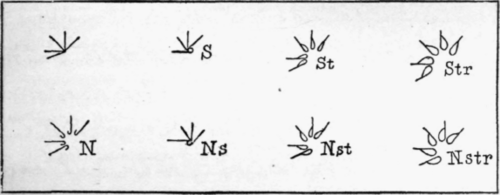
When the St or Str loops terminate a word, the letter N may be indicated in a manner similar to the foregoing indication of the letter R. It is done by writing the St or Str loop, as the case may be, on the N hook side of a letter, thereby clearly indicating N without writing it. Compare signs 86 with 87 and 88 with 89. This is on the same principle as the Ns circle, which sort of terminations are illustrated below:
As will be seen in Exercise, the St and Str loops are added either beginning or ending a word, and in some combinations may easily be employed in the middle of a word. See sign 100.
When the circle S is the last consonant of a word, and is immediately preceded by the loop St, Sd or Str, the circle S may be added to those letters, as in signs 91 and 92. The St and Str loops are added to the curved letters on the most convenient side, in the same manner as the circle S is added. Signs 72, 77, 93, etc.
The word lesson is written downwards in sign 106, where the words a single lesson, are joined together. This joining is called phrasing and is fully explained in other lessons. When lesson is written alone, it must be written upwards, because L is written upwards when alone.
The word ten in sign 106 is written on the line, because it is a frequently occurring word and may be easily read in that position, which is the fastest position in which to write.
This ignoring of position-vocalization to place words in the position in which they may be most easily read is a principle which students had best not apply to words not explained in these lessons.
Exercise VI
Key VI.
1, roof; 2, remain; 3, cave; 4, gain; 5, puff; 6, bone; 7, tough; 8, down; 9, chaff; 10, June; 11, puffy; 12, downy; 13, roofs; 14, remains; 15, caves; 16, gains; 17, puffs; 18, bones; 19, staffs; 20, downs; 21, chiefs; 22, Junes; 23. China; 24, revives; 25, ration; 26, active; 27, caution; 28, po-tive; 29, potion; 30, dative; 31, tuition; 32, stations; 33, stationary; 34, fun; 35, frown; 36, fashion; 37, vine; 38, evasion; 39, loan; 40, loans; 41, love; 42, man; 43, man's; 44, missions; 45, known; 46, knife; 47, nation; 48, native; 49, shown; 50, shines; 51, dances; 52, prances; 53, tenses; 54, bounces; 55, possession; 56, decision; 57, transition; 58, transitions; 59, translation; 60, Johnson;.61, Wisconsin; 62, post; 63, praised; 64, blest; 65, trust; 66, staid; 67, roast; 68, storm; 69, stick; 70, stag; 71, streak; 72, stream; 73, test; 74, toast; 75, toaster; 76, stride; 77, fast; 78, list; 79, steel; 80, stiff; 81, mist; 82, stop; 83, stopper; 84, strop; 85, stropper; 86, chaste; 87, chanced; 88, poster; 89, punster; 90, coast; 91, coasters; 92, spinsters; 93, fluster; 94, bolster; 95, faster; 96, strife; 97, strive; 98, string; 99, strangle; 100, justify; 101, affective; 102, affectively; 103, affection; 104, affectionate; 105, affectionately; 106, A single lesson well gotten surpasses, ten merely glanced through.
Continue to:


My Books

