


Lesson VI. Final Hooks
Description
This section is from the book "Haven's Complete Manual Of Practical Phonography", by Curtis Haven.
Lesson VI. Final Hooks
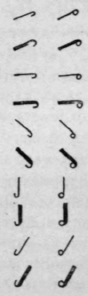
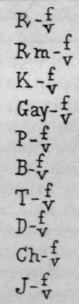
A small final hook, written on the right-hand side of upright and slanting straight characters, and on the upper side of horizontal ones, represents the addition of either F or V. Signs 1, 3, 5, 7 and 9, in Exercise. S or Z may be added to this hook by writing the circle within the hook. Signs 13, 15, 17, etc. This F or V hook is not intended to be added to the curved letters F, V, etc., although some writers use a small shaded final hook on curves to represent F or V, as in signs 41 and 46.
A similarly sized final hook, written on the left-hand side of upright and slanting straight letters, on the lower side of horizontal ones, and added in the most convenient manner to curved letters, represents the addition of N. Signs 2, 4, 6, 8 and 37 in Exercise. The S or Z circle is added to this hook, on curved letters, by writing the circle within the hook (signs 40, 43 and 50); and to the straight consonants, by converting the N hook into a complete circle (signs 14, 16, 18, 20 and 22), in a manner similar to that by which S is added to Per in Lesson V (The Beginning Hooks). This conversion of the N hook into a circle, forms what is called the Ns circle, which need not be mistaken for the plain circle S, because the original circle S is written on the right hand side of straight, upright, and the upper side of horizontal characters. The following cut illustrates these hooks exactly and also the manner in which the S and Ns circles are added to them.
R-n.
Rm-n
K-n
Gay-n
P-n
B-n
T-n
D-n
Ch-n
J-n
R-ns Rm-nS
Gay-ns
P-ns
B-ns
T-ns
D-ns
Ch-nS
J-nS
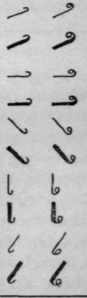
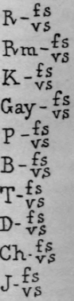
The Ns circle may be enlarged to represent the sounds of Nses or
Nzes, signs 51, 53, etc, the Nses circle really being a Ses circle written on the N hook side. Neither the Ns circle nor the Nses circle are ever added to curved letters.
A large sized final hook, written on the same side of full sized consonants as that to which the F or V hook is added, represents the addition of the sounds Vive, Viv or Tiv. Signs 26, 28 and 30 in Exercise. The Tiv hook, like the V hook, is not intended to be added to curved letters, but some writers use a large shaded final hook on curves to indicate Tiv, as in sign 48. The objection to these shaded final hooks is that generally they have to be written backwards and as it is often hard to form them, it is quite as easy to write the V or Tiv in full.
A large final hook, written on the same side of full sized consonants as that on which the N hook is written, represents the addition of the sound Shun, as heard in the words represented by signs 25, 27, 29 and 31 in Exercise. By consulting below diagrams, it will be seen that the Shun hook is an enlarged N hook, the letter N being the last sound in Shun. Similarly, the Tiv hook is an enlarged V hook, the sound of V being the terminating sound of Tiv.
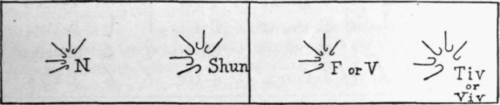
Some phonographers write the Shun and Tiv hooks transposed, but this is very inadvisable, for many reasons. For instance, by writing the Shun hook on the under side of K, the word affectionate (sign 104) is very easily written, but write the Shun hook on the reverse side and the student will find that he can write as far as the sound Shun in the word, but when he attempts to add the final syllable ate, his Shun will be spoiled entirely. This will never happen in writing the syllables Shun or Tiv in the positions prescribed in these lessons. The only syllables which are most likely to follow Tiv are ly or ness, the latter being easily added in either case and the former {ly) being easily added to Tiv only when Tiv is written upon the side prescribed in this lesson. See sign 102 in Exercise. Then again, it is much more reasonable to suppose that Tiv, containing a V sound, should be written on the same side as the V hook, and the syllable Shun, containing an N sound, should be written on the same side as an N hook, an arrangement which is also a great aid to the memory.
The circle S or Z is added to both the Shun and Tiv hooks, by enclosing the circle S or Z within the hooks in the manner illustrated by signs 24 and 44 in Exercise. In adding the circle to these large hooks, care should be taken that this addition does not crowd those large hooks into a resemblance to the smaller F or V or N hooks. This is easily avoided by making the large hooks somewhat larger, when adding the circle, than ordinary. The following schedule, which shows how the Shun and Tiv hooks are added to straight letters, gives the proper sizes for the hooks, with or without the circle S.
R-shun
Rm-shun
K-shun
Gay-shun
P-shun
B-shun
T-shun
D-shun
Ch-shun
J- shun
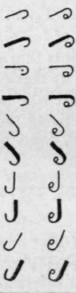
R-shuns Rrn- shuns K-shuns Gay-shuns P-shuns B-shuns T-shuns D-shuns Ch-shuns J-shuns
R-tiv
Rm-tiv
K-tiv
Gay-tiv
P-tiv
B-tiv
T-tiv
D-tiv
Ch-tiv
J-tiv
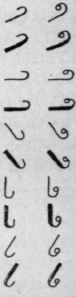
R-tivs Rm-tivs
K -tivs Gay-tivs P-tivs B-tivs T-tivs D-tivs Ch-tivs J-tivs
Below we give a table showing how the hooks are added to curved letters:
F-n
V-n
Th-n
Sh-n
L-n
M-n
M b/p-n
N-n
Ng-n
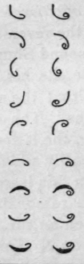
F-ns
V-ns
Th-ns
Sh-nS
L-ns
M-ns
M b/p-ns
N-ns```
Ng-nS
F-shun
V- shun
Th-shun
Sh- shun
L-shun
M-shun
M b/p-shun
N-shun
Ng-shun
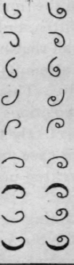
F- shuns V-shuns Th-shuns Sh- shuns L-shuns M-shuns M b/p-shuns N-shuns Ng- shunS
In sign 49 of this Exercise, the N hook of the word shown is apparently written identically the same as the L hook in the word facial, sign 53 in Lesson V (The Beginning Hooks). This resemblance, however, is only a seeming one. The L hook, when added to Ish, should never be mistaken for an N hook, for the following reasons: First, when L and Ish are the only consonants in a word, the L hook is not made use of, Ish being shaded to represent the L in words of one syllable, as in sign 43 in Lesson V, or written full sized in words of two syllables. Second, the Ish in signs 52 and 53, Lesson V, is written upwards, and, therefore, the hook attached to it must be a beginning hook, for, were it a final hook, the Ish being written upwards, the hook would be written on the upper end. Third, the hook in signs 52 and 53, Lesson V (The Beginning Hooks), being a beginning hook, it could not be N, for N is a final hook. Fourth, the L hook never being added to Ish, unless some other consonant is contained in the combination, and the R hook being added to Ish only as in sign 42, Lesson V, therefore, the hook in sign 49, this Exercise, must be a final hook, and being a small final hook must be N, for F and V hooks are seldom added to curved letters, and are then shaded, which is not the case with the hook in sign 49, this Exercise.
In Lesson IV (Additional Use Of The Visible Vowels), promise was made that a rule would be given which would determine the difference between the words fun and funny, and other similar words in which N is the final consonant. The instruction now presented has prepared the student for this explanation, the second paragraph of this lesson directly providing for the distinction. In other words, fun and words terminating with the letter N, are written with the use of the hook N (sign 34), while words ending with the syllable ny are written with the Visible Alphabet sign for N, the final vowel sound thus, by this distinction in outline, being indicated invisibly, as in sign 65 of Lesson IV. Compare also, in this lesson's Exercise, signs 5 and 8 with 11 and 12. In sign 23, the concluding vowel sound is written, because China is a proper name.
Just as the beginning hook in the word stickler, sign 87 of last lesson, was slighted to make a juncture, so can the final Tiv or Shun hooks be slighted when necessary, as in sign 33 in Exercise to this lesson.
The sounds of Sesshun or Sisshun, as heard in the words possession, decision, etc., are nicely represented by continuing the circle S, when added to full sized consonants, into a hook, as in signs 55 and 56. The Ns circle, continued into the same kind of a hook, may similarly represent the sound of Ensisshun, as heard in the word transition, sign 57. An additional circle S is added to these hooks, as in sign 58. The Ns circle may occasionally be continued over to add a final sound of N, as in signs 60 and 61, where the circle and hook read as N-sn, without clashing with the Ensisshun hook.
Continue to:


My Books

