


Simple Attack And Defense - Standard Formations. Part 5
Description
This section is from the book "Football For Public And Player", by Herbert Reed. Also available from Amazon: Football for Public and Player.
Simple Attack And Defense - Standard Formations. Part 5
When the last man in the diagonal is five yards behind the line of scrimmage the formation contains the threat of any play possible under the rules, and has the still further advantage that the order of the men in it may be changed from time to time, being sometimes led by the fullback, sometimes by a halfback. This echelon effect permits of the direct pass from the center when used behind a balanced line, and is very useful as a "jump back" shift behind a shifted line, a play successfully used in recent years by the Navy and lesser teams. With a guard and tackle brought over in front of the diagonal, so that both guards and tackles are "twinned" there is a double threat of a quick opening which is very effective. And this is true whether the line shift be made by the "jump" or "slide" process, or on quick line-up, the last named, I believe, as good as any.
Fig.4. "L" FORMATION. Lin© Defence.
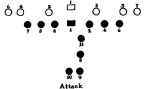
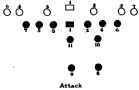
Fig.5. SQUARE FORMATION. Line Defence.
The "L" formation, Fig. 4, is not common, but it has its uses none the less. It contains a straight tandem, which may easily swing into a kick or pass formation, and which contains the threat of both. From it a sharp drive into the line may be made, and it is very useful for end or tackle runs. The direct pass may be made to any of the backs when the center is a dependable handler of the ball, and the quarter can get into action without any difficulty.
All the formations so far discussed are very handy when the team boasts a good end runner, but when the backs are all big and rugged and the line unusually powerful the situation changes to some extent. In such circumstances there is no better formation, I think, than the simple square, so effectively used by Harvard in recent years, and so widely adopted in the East in 1912. In that season Harvard made the most of it, Yale adopted it but robbed it of half of its efficiency for the greater part of the season by using the direct pass from center on every play, while Princeton ignored it altogether, the Tigers being wedded to the Minnesota shift, three-rank style, which at the speed it was handled, suited their purpose admirably.
In the square. Fig. 5, the backs must all be good individual interferors, prepared to take a line man single handed if necessary. From this formation, which reeks with power, a heavy, grinding backfield will wear down anything but the sturdiest defense. It is well adapted to shifting combinations, now one back, now another appearing at the "business" corner. It may be expanded and contracted without limit, may be formed immediately behind center, or may take post to the right or left of the middle of the line. The square requires less faith in deception of the opponent than most of the simple formations, and depends for its success upon supremely good and powerful individual play.
The formation is most satisfactory for sudden drives off the guard position, the runner veering out as he passes the line of scrimmage, or turning in sharply, according as one member or another of the secondary defense is put out of the play. As a rule one of the two "front" backs should be the heaviest man in the backfield. This formation, used as Harvard employed it, with the ball invariably passing through the hands of the quarterback, should provide high-class attack throughout the season - in the big game as well as in October. It lacks bewildering complication and yet is sufficiently elastic to serve for any sort of play, kick and forward pass included.
In building up any formation the coach sticks to simplicity as far as possible, combined with utility, so that the formation becomes a habit with the backs and the men do not have to think consciously about finding their places. Whatever is done in the way of elaboration later in the season must be based on the sound fundamental formations that have been put to the test and not found wanting; otherwise a team will find itself facing its big game equipped with a great variety of plays that require an enormous amount of quick thinking, plays of which the backs cannot be sure, and which are likely to be torn apart by the defense in their incipiency. Better a few sound formations with simple plays therefrom, superbly executed by men conscious of their power, than a vast amount of "dress parade" that never gets anywhere.
Toward the end of October, when the players are thoroughly familiar with the groundwork of the attack, and can execute the plays doled out to them as if by second nature, it is time to give the entire eleven more than an inkling of what sort of grand tactics are to be used in the big games. Every man on the team should be taken into the confidcncc of the strategic coach to a large extent. This is good for the morale of the eleven, inspiring even greater confidence in the coach, in the players themselves, and in their knowledge of the coach's confidence in them. It is at this stage that advanced football begins to be the order of the practice, that the "joke" forward pass used in the lesser games is abandoned, and the finesse of the polished game brought home forcibly to the men. It is the period for which every man has waited and worked from the beginning, and the burgeoning of the larger scheme of campaign cannot fail to instil new life into what by this time may have become a tired team.
There is only one thing to guard against, and that is the premature use of the team's "best stuff." The time may come in a game with one of the big elevens just prior to the all-import ant match of the year, when golden opportunity stares the quarterback in the face, when he knows that by using one of the plays reserved for the greatest rival he can defeat a lesser, but still a "big" team. The temptation is more than most field generals can stand, and for that reason it may be well to withhold from him the culmination of the "scoring" play, the complete plan, lest he be tempted to use it and thus expose it to the watchful eyes of the scouts from the rival team which it is most desired to conquer. The situation does not often arise, but when it does it would be well for the head coach to be prepared for it in the manner indicated. In a word, no team should be an absolutely finished product, an absolutely polished organization, until the day of its greatest game.
Continue to:


My Books

