


Simple Attack And Defense - Standard Formations. Part 4
Description
This section is from the book "Football For Public And Player", by Herbert Reed. Also available from Amazon: Football for Public and Player.
Simple Attack And Defense - Standard Formations. Part 4
It is perhaps needless to explain that the success of simple plays like these, depending on a back of individual power and speed, and forwards skilled in individual interference, must go with the precision of clockwork, the runner arriving full speed at the opening the exact instant it is made. If the man with the ball is to be sent through first it is sometimes a good plan to further spread the first line of defense by putting eight men on the attacking line.
The whole underlying theory of the play is to begin the run itself and the interference as close to the firing line as possible, and to get the utmost possible execution out of the play after it has passed the line of scrimmage. In such plays, of course, the forward pass threat is at a minimum, save when a man is wasted to make the bluff; but with good, husky material in the line, and quick, heavy backs, there is a fair chance of success. A series of plays of this character will, even if unsuccessful, tend to pack up the defense, both primary and secondary, thus paving the way for a long gainer, which may catch the defense in an entirely too concentrated position. .
The use or lack of an interferer will depend entirely upon the individual capabilities of the backs, and the ability of the forwards to make quick openings. If the forwards are able to make clean openings, if only for the fraction of a second (and they complain nowadays that the neutral zone between the two lines makes this extremely difficult, since it is hard to reach their men promptly) the man with the ball may be shot in at once, but if they are able to barely start the opening it may prove a good plan to throw in a big, powerful back ahead of the runner, in the hope of adding just the necessary amount of smash to split the defensive line apart. Nothing but constant trial will solve the problem.
In the old days when pushing and pulling of the runner were permitted it was a sound rule of football always to send the man with the ball into the line first. This was what a certain famous coach referred to as "putting the power behind the ball." Nowadays it is often necessary to put the power in front of the ball, and this has become increasingly the case since many teams have developed individual interference to a high degree of excellence. Simple end and tackle runs may be made from the normal formation, as they have been in the past, depending for their success less upon complicated interference than upon smooth execution, even though the positions of the back with the ball and the interferers be fairly obvious. These runs may be made from the direct pass from center to the back, or with the ball passing through the quarter's hands, for it is a poor quarter indeed who is kept out of end run interference through the necessity of handling the ball.
With the direct pass, however, the end swinging around from the side opposite to that on which the play is made must be used to cover the play, and so is lost to the interference, whereas with the ball passing through the quarter, he is able to get into action with the tackle or guard as the case may be. With carefully devised plays, the simple, old formation shown in Fig. 1, should account for some good gains through the month of October and even later in the season.
The diamond formation, Fig. 2, is a favorite with a great many coaches East and West, especially with those who favor a considerable use of the direct pass from center, to which it is excellently adapted. Like the normal formation, the diamond is well suited to use behind a balanced line, having the regular frontal and bi-lateral threats. It is especially useful in end runs in that Nos. 8, 9 and 11 are already in position to take the direct pass from the center, and No. 10 can easily recover any fumble or bad pass without making use of a covering end, and when stationed five yards back of the line of scrimmage is excellently posted to make the forward pass, the threat of that play, or kick, with the other backs dropping easily and swiftly into the regular kick formation.
The direct pass should never be made to No. 10, to my way of thinking, in any part of the field, and certainly not when the team is deep in its own territory. They still speak feelingly of this at New Haven, for an error of this kind once cost Yale the Princeton game. On the occasion in question the pass was made to Dunn, the last man in Yale's diamond, and as the backs started too soon, and the pass itself was poor, Dunn failed to connect with the ball, and the yellow egg lay loose in the mud for Sam White of Princeton to pick up and carry to a touchdown. Herein lay the chief fault in the formation, the uncovered last man in the backfield. It was also a dangerous play in the part of the field chosen by the Blue for its use, for the ground and the ball were slippery, the Elis knew Sam White's specialty, and the team was much too near its own goal line to take such a raw chance.
With the diamond formation in action, and carefully covered by an end, the ball may be shot to any one of the backs, who, making a lateral start, is not slowed up even the smallest fraction of a second. He also finds his interference practically already formed. From this formation the forward pass and the kick may be made with the minimum of excess maneuvering, the backs have no difficulty in find-lag their positions as they do when the shifts are used, and the plays can be started at top speed. The scheme is an especially good one for a team that boasts the services of a "shadow" end runner with one big back to lend variety and power to the attack.
Fig. 2. DIAMOND FORMATION. Line Defence.
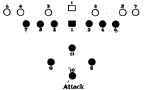
Fig.3. DIAGONAL TANDEM FORMATION. Line Defence.
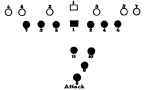
Another simple formation that has many of the virtues of the diamond is the tandem, either straight or diagonal. Figure 3 gives an idea of the diagonal form. The tandem was especially valuable in the old days, for it was compact, it was not easy to tell which man of the three had the ball, and it had and still has a terrific amount of "drive," for although pushing is not allowed nowadays, the man with the ball may be rammed forward by a series of impacts by the other members of the tandem. The formation also contains the threat of false attack and its consequent "split-off" so successfully used by Harvard when Bill Reid was coaching the Crimson, and works nicely with the delayed pass.
Continue to:


My Books

