


Start Of The Forward Pass. Continued
Description
This section is from the book "Football For Public And Player", by Herbert Reed. Also available from Amazon: Football for Public and Player.
Start Of The Forward Pass. Continued
The third element, protection, is not so difficult as the other two, for a back may protect the passer as he does a kicker and then go down the field to cover the pass in case it is intercepted. In the diagram (Fig. 12) the protector is a line man. In the diagram (Fig. 13) there are two protectors, a hue man and a back, while in the diagram (Fig. 14) the protection is afforded by the fact that the ball crosses the line of forwards, the "receiver" No. 7, at the right of the diagram, being only a bluff to draw the defense while the real receiver is found in No. 6.
I should not advise school elevens to try to use a line man as a protector, for it takes a skilled and active forward to cover the ground and get out where he will be of service, and even some of the big teams cannot use a line man as a protector. I have used line men as protectors in the forward passes shown in the diagrams because there have been many eases of their successful use, and I expect to see this feature of the play still further developed.
Fig.13 LONG FORWARD PASS. (FROM KICK FORMATION).
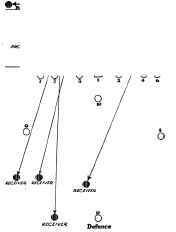
In the diagram (Fig. 12) is shown a sample of a short forward pass with the maximum number of receivers down the field. The play is made from the square formation of the backs. Since one man may be in motion toward his own goal line before the ball is snapped, No. 11 takes a flying start and turns to his left, receiving the pass on the run. He continues the run a short distance, careful always to be five yards behind the line of scrimmage, and then turns to locate his receivers. He is covered by the tackle, No. 5, who crosses from his position. Nos. 6, 7, 8, 9, and 10 go down the field with the snap of the ball, following the courses indicated in the diagram. The pass is made to the man in the best position to receive it. The run should have pulled the defense to the left, but since there is no protector to cover No. 9 the pass should never be made to him unless the nearest man of the defense has been drawn many yards away from him. If, however, the pass goes to No. 7, an interception thereof may be covered by No. 9, The play will have to be fast, for the distances are short.
A fair sample of the long pass is shown in the diagram (Fig. 13). In this the kick formation is assumed, but the centre instead of passing for the kick passes to No. 11 who holds the ball long enough to draw in the defensive end and then tosses it to No. 10, who makes the second delay by a run to the right, Nos. 11 and 5 crossing over as protectors. Nos. 6, 7, 8 and 9 go down the field with the snap of the ball, following the courses indicated in the diagram. When No. 10 sees his men in position he sends the ball away to the man who seems to have the best chance of receiving it, The defense should find considerable difficulty in covering the four men. The pass from this formation is easily varied by a run from time to time.
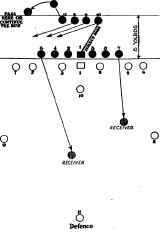
In the diagram (Fig. 14) is shown a forward pass that may be turned into an end run. In this case, as explained above, no protector is necessary. The center makes a direct pass to No. 10, and Nos. 8, 9 and 10 start for the right as indicated by the arrows. At the snap of the ball Nos. 6 and 7 go down the field, taking the courses indicated in the diagram. No. 11 drops back as the run is started so as to be five yards behind the line of scrimmage and receives the ball from No. 10 as the latter goes past. The run is continued until it is apparent whether the secondary defense will be drawn up or will stay back. If it stays back the play is turned into an end run, whereas if it comes up the pass is made to No. 6.
Fig. 14. CHOICE of END RUN or PASS.
These three plays are slight variations of others that have been in actual and successful use, and serve to illustrate, I think, the three principles of the pass. One of Harvard's passes in which the ball is thrown to the spot where the runner is to arrive is illustrated elsewhere in an actual photograph.
One last caution. The pass was never intended as a short cut to victory, but as a sound football play to be carefully worked up in conjunction with the rest of the attack.
In returning to the subject of generalship I cannot begin better than by asking the reader to compare the two full field diagrams already given (Figs. 1 and 8), especially in the matter of the zones. In the first of these the zones are laid out for a team supposed to have a powerful and versatile running attack, in the second the arrangement presupposes that the team is very strong in kicking and has practically no attack ball in hand. If these two arrangements of zones are sound, then some combination of the two will give a reasonable plan of generalship to the team that is of all-round calibre. If the team be a shade the stronger in kicking, then that is the point that will be emphasized, and if just a little overbalanced in running then it is upon that form of attack that the emphasis will be laid. One thing must never be forgotten, however, and that is that it is far better to kick too much than, run too much.
So far in this study of generalship it will be noticed that I have always spoken of the team as having the wind behind it. This is for the simple reason that there is nothing for the team against the wind to do but use the running game for three downs even on its own side of the field, and kick low and hard and out of bounds on the fourth, with an occasional and carefully covered forward pass. Such a team must run its plays slowly, playing for time, and making as little exertion as possible so as to be fresh when its turn comes with the wind. There is this variation, however, that should a misplay by the enemy give such an eleven possession of the ball within reasonable striking distance the full strength of the running and passing games should be turned on in the effort to score, for the team that can score against the wind is quite likely to get the whip hand. Furthermore, the most powerful backs, who hitherto have been kept waiting on the side lines should be thrown into the game to seize their chance, the desultory and time-saving running game having been carried on by the second string backs who will not be used when the real running attack is turned loose.
Now if there is no wind at all, both teams, I think, should play about as they would if each had a mild wind behind it. This would mean that both sides would use the same fundamental generalship and the cleverest plays executed by the cleverest men would probably carry the day. The choice of these particular plays and their execution would show up above the broad base of the generalship that does not make mistakes.
Perhaps the best way to reach the combination idea of kicking and running under the modern form of generalship, is to lay out for a hypothetical team a chart somewhat on the style of that shown in the diagram (Fig. 15). For purposes of illustration and elucidation it is considered that our team has the wind and is receiving the kickoff, and that the wind is blowing diagonally down the field as indicated by the arrow in the diagram. Should the wind be straight down the field it means simply that we shall be saved the down that is required now and then in order to get to windward. Should the wind be blowing straight across the field it means that this windward down must carry us a greater lateral distance than would otherwise be necessary. So for the sake of illustration we are justified in assuming that the wind will be blowing about as indicated. The field is divided, then, straight down the middle, into windward and leeward zones, and every step we take, or nearly every one, down that field, will have to be taken with reference to our position in one or the other of these zones. One thing more before taking up the play - we must take for granted that we are facing a team that has no special weakness requiring special change in the generalship. Now to our game. If in receiving the kickoff we cannot run it back beyond the twenty-yard line we shall find ourselves in either the upper or the lower quadrangle at the extreme left of the diagram. Having the advantage of the wind our first thought is to get on across the middle line as quickly as possible and with the least expenditure of effort. Obviously, then, we shall kick as high and as far as possible, the height being for the benefit of our ends whom we expect to hold the ground covered by the kick. If kicking from the upper quadrangle we shall do so on the first down that there may be no delay whatsoever. We do not want to run for another reason - because this is no situation in which to risk a fumble by passing the ball through the hands of three men. Further, we do not wish to give our opponent an idea of what sort of running plays we may have, lest he have them diagnosed when we get into his territory.
Fig. 15. A SAMPLE GENERALSHIP CHART.
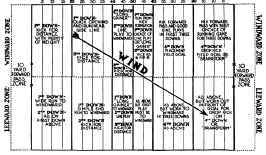
Photo. by Paul Thompson.
Continue to:


My Books

