


Start Of The Forward Pass
Description
This section is from the book "Football For Public And Player", by Herbert Reed. Also available from Amazon: Football for Public and Player.
Start Of The Forward Pass
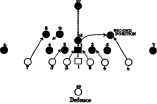
The passer, indicated by the cross (X), has made the necessary delay and will pass the ball to one of two eligible receivers, indicated by the arrows ( {), who are getting down the field and out to their stations. The defense cannot tell which man is to receive the ball until after the pass is actually made. The passer has been covered by a regular kick formation.
The forward pass is perhaps the most rabidly discussed play in football to-day and there are hardly two first-class coaches in the country who take exactly the same view of its use. In some cases it has been used too often, and in others too seldom. It has won games for the team using it, and has cost games for the same team. "It is a boomerang," says one coach; "it is a play with a kick in it," declares another.
Fig.11 "BLOCK Kick" FORMATION.
Now the forward pass is quite as valuable as a threat as an actual play and it was more because of the chance that the threat of it would spread the defense than because it would work wonders as an actual play that the Rules Committee adopted it. In its first year very little use of it as a threat was made, and there was much grumbling because the play itself seemed so uncertain and was so often intercepted for long gains by the defense. Any time a back-field lines up with one man five yards or more behind the line of scrimmage the defense is menaced with a forward pass. Even if the pass is not forthcoming the menace must be reckoned with and there must be an opening out of the defense. It is its judicious use as play and threat both that marks the wise coach.
Perhaps the best criticism of it as an actual play was the danger to the team making it, for as kicks may be run back so may forward passes, and since the men sent down under the pass will be engaged in seeking to snatch the ball, rather than in watching the defensive backs, they will hardly be in advantageous position to bring down the interceptor of the pass, and there should be a great chance for a fast, alert, dodging back on the defense against the advance fling. With a quick getaway from the forward pass "eli-gibles," usually four in number, he will have to thread his way through a well-broken field of only seven men. His principal trouble should be in the form of the tackles, for they will come storming down the field for the very purpose of nailing the defensive back, albeit a man or two of the attack will have to be left well back up the field to guard against accidents. Of course an intercepted long pass is hardly as dangerous as an intercepted short pass, but there is danger in it just the same.
The long pass has the advantage that it need not necessarily be hurled very far to one side, and the players will be pretty well spread, whereas the short pass often goes sharply to the side and is, therefore, a trifle risky in the face of fast defensive backs. On the other hand, the short pass can be shot almost on a flat trajectory to its recipient, whereas the long pass often has to be flung rather high, to some prearranged spot, ball and man arriving almost simultaneously.
Coaches differ as to where the line should be drawn between passing direct to the man and to some unoccupied spot, and as there are many minds there have been many plays in the past and will be many in the future to test the various theories. There is no denying the value of the play in attacking territory, no denying its possible value as a scoring play, yet for all that the forward pass zone behind the goal line was added in the rule-making less in the hope that the attacking team would make a touchdown with the play than in the hope that the threat of it would so spread the defense that the attack would have at least an even chance of crossing the line with the running game as a climax to a steady, well-planned and well-executed advance, ball.
The elements of the forward pass are three - deception, delay, protection. It is obvious that no team making the pass wants the opposing eleven to know when it is coming. To this end it may be made from a variety of formations and threatened as well as actually made from regular formations which just before the ball is snapped do not have one man five yards back of the line of scrimmage. A player may one time run back as if to make the play and not make it; another time run back and actually make it. Again, the threat of it - that is with one man five yards back as the teams line up - should be cleverly mixed up with the actual play made from the threatening position. The pass should sometimes be made from the kick formation, and indeed, the fear of it should be in the hearts of the enemy most of the time. It might be objected that the enemy always being on the watch, the play would fail both as a threat and as an actual ground-gainer. This argument fails because of the fact that the defense must face other plays and handle them and so be out of shape to handle the pass. The deception may be made even when men are going down the field ostensibly to take the pass, and the rest of the team well in motion, by the simple process of the back continuing his run.
Fig.12 SIMPLE SHORT FORWARD PASS.
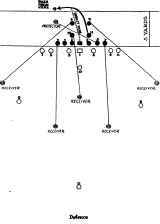
The second element, delay, is the most difficult. Various subterfuges have to be resorted to behind the line to give time for as many eligible men as possible to get down the field. In the case of a short pass less delay is needed, but even here it is valuable, for if the passer has the maximum number of human targets at which to shoot, he will the more quickly find one of them uncovered by the defense, for the defense cannot possibly cover five men. Four men will make serious trouble for the defense, and in the case of very short passing I have seen the play work when the passer had only one eligible to whom to hurl. In the accompanying diagrams (Figs. 12, 13 and 14) I have shown three examples both of deception and delay.
Continue to:


My Books

