


The Story Of Bees
Description
This section is from the book "The Busy Little Honeybee", by Josephine Morse True. Also available from Amazon: The Busy Little Honeybee.
The Story Of Bees
Children's Science Series
Compiled by workers of the Writers' program of the work projects administration in the Commonwealth of Pennsylvania
Junior Press Books
Albert Whitman & Co.
Chicago 1940
Preface
The Story of Bees is the fourth in the Children's Science Series. It was prepared by the Pennsylvania Writers' Project, sponsored by the Pennsylvania Department of Public Instruction.
This booklet was written by Mark Bartman and edited by Katharine Britton, Field Editor.
Acknowledgment is made to John W. Cadbury, 3d, Assistant Curator of Insects, the Academy of Natural Sciences of Philadelphia, for acting as consultant in assuring accuracy of the text and illustrations.
Color illustrations for jacket and book are the work of David Cain. All other illustrations are the work of Mary Procopio.
Conrad C. Lesley Acting State Supervisor

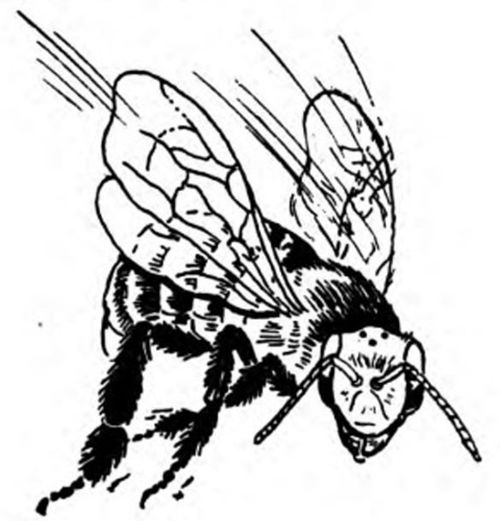
The Worker Bee is Busy from Sunrise to Sunset.
The Story Of Bees
There is an old story told to show how wise King Solomon was. But the story really tells how wise the Bee is.
It happened this way. Several thousand years ago in the kingdom of Israel, some men were arguing about King Solomon's wisdom. One of them said that the King, wise as he was, could still be fooled. The other said that no one could fool Solomon.
They decided to put the King to a test. One of them picked a flower from the field and the other made a false one exactly like it. Indeed the flowers were so much alike that it was the hardest thing in the world to tell the difference.
Then the two men came before the King and knelt at his feet, holding out the two flowers.
"O Most Mighty King, " they cried, "your goodness and understanding are spoken of far and wide. We wish very much to test your wisdom so that those who doubt you will be ashamed. Here are two flowers alike as two peas in a pod. No one but the maker can tell which is real and which is false. Show us, O Great King, which is the true flower and which is the untrue, and your enemies shall be made weak by the strength of your wisdom. "
King Solomon took up the flowers, smiling. He looked at one and he looked at the other. Truly, they were alike as two peas in a pod. Each one's petals were just as rosy as the other's. Each one's stem was just as green as the other's. Each one's smell was just as sweet as the other's.
And for a while Solomon himself could not for the life of him tell the difference. He just sat and sat there, with a frown on his face. But suddenly he began to smile again. For nearby he heard the buzzing of his friend the bee. Closer and closer the bee came, close to Solomon's head. Then, whirling about for a moment, it settled on one of the flowers.
Then the King gave a great laugh. "This is the true flower, " he said pointing, "and this is the false. " And everybody marveled at his wisdom. But King
Solomon knew that it was not he who was able to tell the difference. It was the bee who had shown him.
Telling a real flower from a false one is a very easy thing for a bee to do. The bee is a wonderful little creature and she knows many things. She knows how to make wax. She knows how to gather nectar and turn it into honey. She knows how to change an ordinary worker bee into a beautiful Queen bee. She can fly miles from her home and never get lost.
But the most wonderful thing about her is that she is the only insect in the world that makes something that man can eat. There are a few other insects that make something that man can use. One of these is the silk worm, but he only makes something for man to wear.
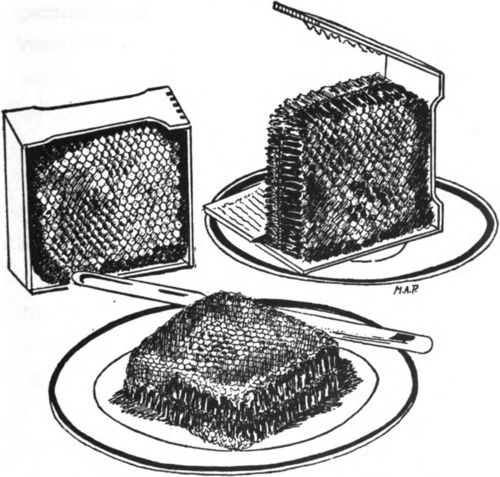
The Thick Syrupy Honey which Comes to Our Table.
With the break of dawn and the opening of the flowers, the worker bee leaves her hive to begin the day. From morning till night she visits the morning glories, the roses, the fruit blossoms, and other flowers, sucking nectar from them and gathering pollen as she goes. The nectar is the sweet juice buried in the flower.
Pollen is the golden dust that can be seen in the center of a blossom. The bee picks up so much of this golden dust that she cannot hold all of it, and some drops off on other flowers. When the right kind of pollen falls on a flower, the seeds of the flower become ripe. Then, when the seeds are planted, more flowers will grow from them. So bees are a big help to farmers.
Heavily loaded with nectar and pollen the bee flies back to her hive. Sometimes she lives in the hollow of a tree. Sometimes she lives in a hive that has been made for her by a farmer. If she lives in a tree, bears and other wild animals may steal her honey.
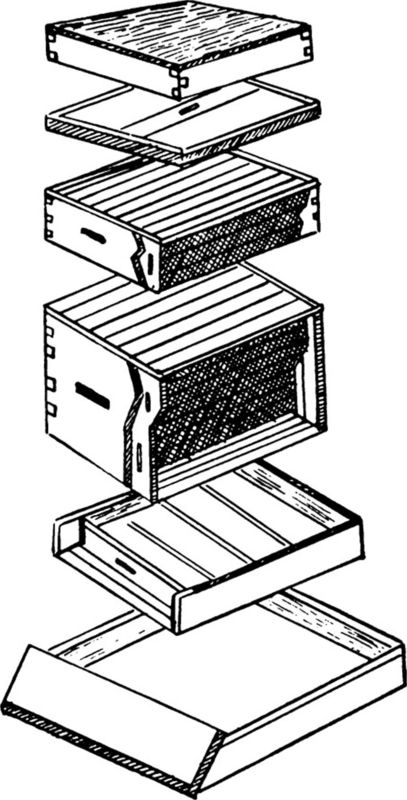
The Hive Looks like a Box of Drawers.
If she lives in the farmer's hive, the farmer takes the honey.
But the farmer is kinder than the bear, for he leaves enough honey for all the bees to eat.
And sometimes when they don't get enough nectar from the flowers, he gives them sugar-water so they will not go hungry.
The hive the farmer builds looks like a box of drawers, or a tiny square house with many stories. As the number of bees in the hive grows, the farmer will add more stories.
Continue to:


My Books

