


The Hive. Continued
Description
This section is from the book "The Busy Little Honeybee", by Josephine Morse True. Also available from Amazon: The Busy Little Honeybee.
The Hive. Continued
For a month or two during the summer, honeybees are rushed with work, for then much nectar and pollen must be gathered and thousands of eggs and baby bees must be taken care of. At this time the workers truly work themselves to death. Their wings get torn, the golden fuzzy hair gets rubbed off their bodies, and they live for only five or six weeks. But when the flowers stop blooming and there is less to do, worker bees often live for six months.
In cold weather the bees cluster together between three or four of the combs. Even though the temperature outside goes down to zero, they have a way of keeping warm by exercising their wings and legs. They change places with one another, taking turns, and manage to prevent the temperature inside their cluster from falling below fifty-seven degrees. If the temperature should fall lower, the bees would chill and die.
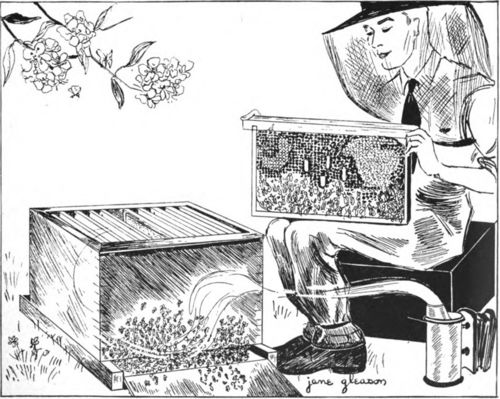
The Center Combs Are Filled with Eggs and Larvae
Honey is the food that grown bees live on. They eat practically nothing else. If they cannot find any nectar or honey, they will eat fruit juices or sugar sirup, but they do not care much for either. They drink water also, and may be seen drinking at the edge of a brook or fountain, or even around the end of a hose.
A colony of bees often makes more honey than it will ever need, but the workers store it away, so that when the weather is bad or when the flowers are gone, they will still have plenty to eat.
For this reason modern beekeepers have on each hive one, or sometimes several, extra compartments, or "supers, " which hold combs for storing more honey. Each super is the same size, though perhaps not quite so deep, as the body of the hive, and fits on the hive under the cover. When the bees have filled their hive with honey, they will build more combs in the supers and fill the cells of the combs with their extra honey. Often when they are gathering a great quantity of nectar they fill as many as three or four supers. An average colony of bees will make about thirty-five pounds of honey in a year. Some colonies make much more.
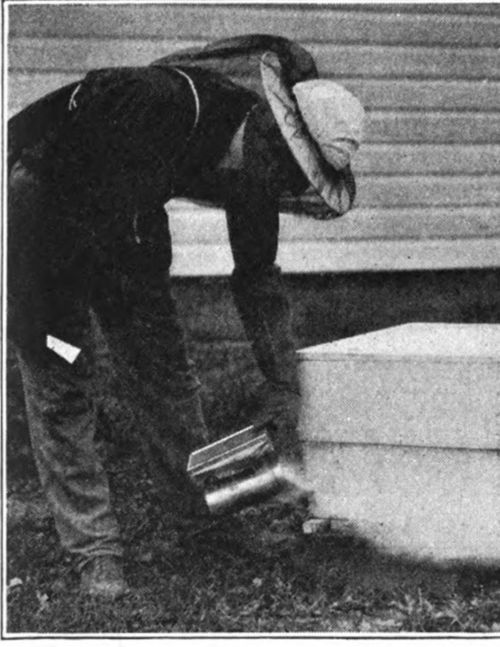
Using a Smoker
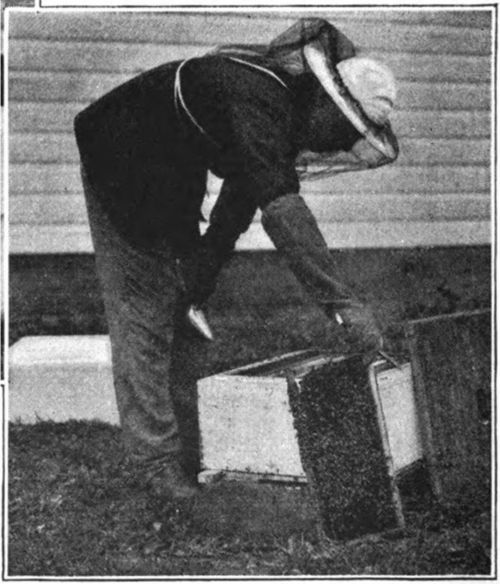
Examining a Comb
Modem hives are made of wood, with a cover which the beekeeper can take off. He can then lift out any combs he wants to look at. The bees build their combs in the wooden frames which hang on rims inside the hive. This arrangement is a great improvement over the old-fashioned way of keeping bees in "skeps. " Skeps are cone-shaped hives made of twisted straw. The bees fasten their combs to the straw inside the skep. The beekeeper cannot take out the combs from skeps to see how the bees are getting along, and it is also more difficult for him to remove the honey. Very few skeps are used in the United States today.
The beekeeper knows just what to do so that the bees will not sting him when he opens the hive and lifts out a frame covered with bees. He carries a "smoker" which is like a small bellows. By pressing on the leather sides of the smoker he can blow smoke into the hive and frighten any bees who show signs of becoming cross at being disturbed. He also wears a "bee veil" pulled down over the crown of his hat and around his face. He can see through it easily, but no bee can get inside to sting his face. If a beekeeper is careless, he may be stung when he opens a hive to see the queen bee and to find out just what his bees are doing; but bees do not often sting unless someone hurts them or interferes with them in or near their home.
Beekeepers find it best to place their hives on boxes or on some kind of stand, so that the hives will keep dry and the entrances will not become blocked with grass.
In some schoolrooms there are hives made with glass sides, so the children can see what honeybees do and what honeycombs look like. Many children's museums also have hives with glass sides, so that visitors may watch the bees at work.
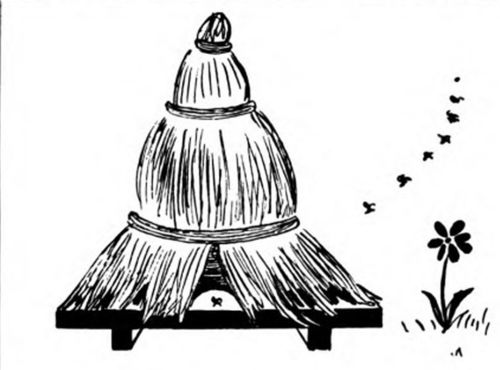
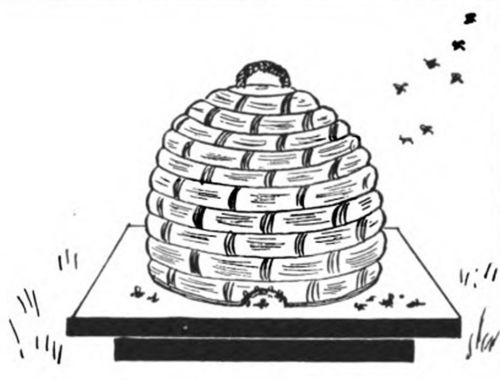
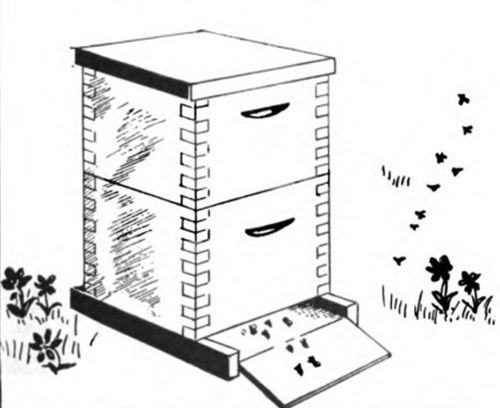
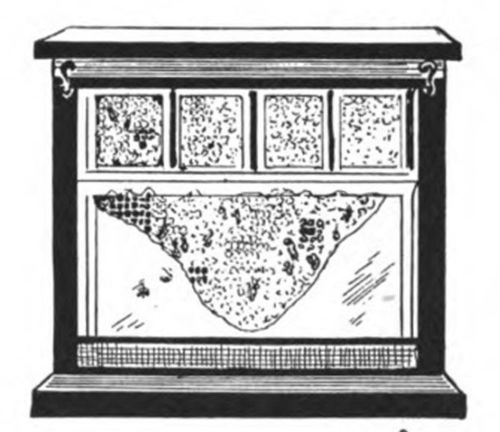
An Old-time Straw Hive, a Twisted Straw "Skep, " a Modern Wooden Hive, and a Glass-sided Hive
Continue to:


My Books

