


The Hall, Vestibule And Stairs. Continued
Description
This section is from the book "Home Furnishing, Practical And Artistic", by Alice M. Kellogg. Also available from Amazon: Home Furnishings, Practical And Artistic.
The Hall, Vestibule And Stairs. Continued
The colour for the wall hangings in the hall may be considered in relation to the two stationary features, - woodwork and exposure. An absence of sunlight may be atoned for by the use of yellow in a depth of shade called for by the conditions. Red, in one of its innumerable tones, will help to diffuse an inviting atmosphere. If blue or green is chosen only the warm tones are advisable.
For a plain wall hanging the ingrain, silk fibre or crepe papers may be drawn from; or, in heavier material, the buckram, crash, burlap, grass cloth, Japanese leather paper, imitation or real leather, jute or other textile fabric. With any of these selections some decoration of pictures or plaster casts will be needed to give interest to the walls.
Striped papers in two tones of one colour look well in a hall when the perpendicular lines are not cut off by a wainscot, or when the ceiling is not very high. A close-set, conventional pattern in two tones is always a safe choice, if the colour is right.
Narrow borders may be used with plain or two-toned papers to make horizontal panel effects on the walls. Corner pieces to fit the borders are manufactured, and the illusion, under a competent paper-hanger, is complete.
Tapestry papers suit halls that are finished in Flemish or dark oak, and in colonial halls the reproductions of eighteenth century picture papers look well with white paint.
A wall paper that is conspicuous in design and strong in colour requires no further decoration, but with a plain surface pictures are a source of satisfaction. Sets of pictures with subjects bearing some relation to each other, different views of one place, or several pictures by one master, when framed uniformly, make a characteristic contribution to the hall walls. Sometimes the wall at the side of the stairs may be hung with small prints, carrying them in an ascending line to the second floor.
The most practical and hygienic treatment for the floor of the hall is hardwood laid with durable rugs. In some houses the stairs are left uncarpeted, but the noise is objectionable; the colour effect, too, of a stair carpet is not to be overlooked in creating an attractive interior.
The best way to fasten a stair carpet to the wood is with the modern invisible appliance underneath the material. Brass rods in flat or rounded shapes are still in existence, and sometimes ordinary carpet tacks are the only fastenings. To soften the tread and prevent the carpet from wearing on the edges of the steps a thick pad is laid next the floor and secured by loops slipped over small hooks.
If carpet is to be chosen for the hall its colouring should harmonise with the walls and woodwork. Plain-coloured carpets are restful to look upon, but not practical at the entrance to the house. Bright colours and showy designs are inappropriate. Borders need not be adopted at all in halls of medium size. Uniformity can be had by using a hall carpet with the runner for the stairs matching in colour and design.
In buying the furniture requisite for the hall it is well to consider that it will not need replacing for a number of years. If the material and workmanship are good and the design simple and artistic, the pieces will not need to be put aside or renewed for changing fashions.
An improvement on the cumbersome combination hall seat, umbrella holder and hat rack was originated in one home by placing a wooden chest under a mirror with hat hooks set in the frame. An umbrella holder of Japanese porcelain was then added near the door.
A small stand for holding a card tray may have its niche near the front door, and a hardwood chair or bench be at hand for the messenger who is kept waiting.
A reliable clock placed in the hall fulfils an all-around service for the house. Many of us have associations with the long-case or grandfather's clock that makes its possession a constant delight, and an ideal choice for the stair landing.
A cuckoo clock has the advantage of not needing a shelf for putting it in position, and of gratifying the musical taste of the children.
Cut flowers do not always find a congenial setting in the hall, but a foliage plant or a pot of blooming flowers set in a jardiniere of pottery or metal contributes so homelike a touch to the entrance way that it may not be forgotten.
Open doorways from the hall into the parlour or library require portieres as a shield or screen. These should hang straight to the floor, just clearing the carpet. Heavy portieres may be run on pulley cords and traverse rings to avoid dragging when they are pulled together.
The vestibule door (leading from the hall into the vestibule) has often a glass of some kind in the upper part, sometimes with side-lights to match. Leaded glass, opaque and colourless, will do away with much vexatious care in screening the hall from observation. In a rented house, where some covering must be used, a plain panel of bobbinet with a design and insertion of lace work may be put up on tiny brass rods at the top and bottom, with a shade on a roller or an over-curtain of silk to draw at night. With dark woodwork the lace panel looks best of ecru colour; if white woodwork is the finish the lace may be white or cream colour. To give uniformity to the exterior appearance of the house the same net and lace used in the parlour may appear on the vestibule door.
The decorations of the vestibule are the sole means for bringing this part of the entrance into line with "the house beautiful." The floor and wainscot of dull-finished tiles in terracotta colour may each have a narrow coloured border as a finish. The upper walls may be painted in buff with a pattern stencilled over in dull, light red. The design of the door, its finish and material and the hardware applied on it, are items to be thoughtfully considered when building or re-modelling.
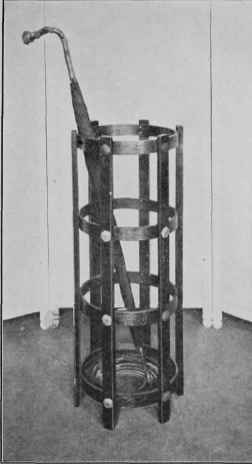
UMBRELLA HOLDER.
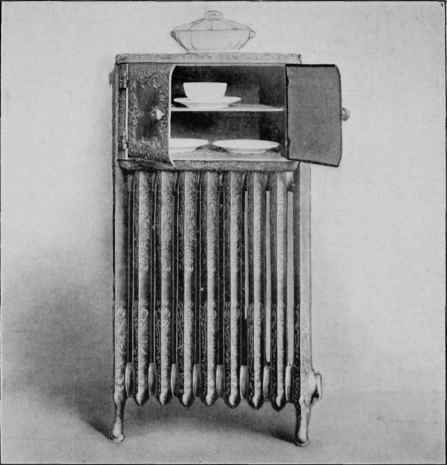
A RADIATOR WITH WARMING OVEN.
Continue to:


My Books

