


XXIII. Lamps And Candlesticks
Description
This section is from the book "Home Furnishing, Practical And Artistic", by Alice M. Kellogg. Also available from Amazon: Home Furnishings, Practical And Artistic.
XXIII. Lamps And Candlesticks
Lamps and candlesticks, even with the perfection attained of late years in other means of artificial lighting, still retain a wide popularity. The sentimental charm that attaches itself to many antique objects and customs is not the only cause for the estimation in which lamps and candles are held. There is a substantial foundation of usefulness underlying the aesthetic enjoyment of the old style, and an occasional dependence if modern methods suddenly fail, that keeps the manufacture of lamps and candlesticks on a permanent basis.
In early New England times candles were universally in use, and their making devolved upon the energetic housewife of that day. As each family usually slaughtered an ox yearly to provide the salt beef that was consumed, there was an abundance of tallow. This was put into the kettle, melted and strained. Then, a ball of candle wick made of soft, untwisted cotton having been purchased, it was cut up and doubled. Twelve of these wicks were strung on a smooth, strong stick the size of a finger, and when they were ready they were immersed in the warm tallow. A coating of the tallow adhered to the cotton wicks, and after being laid aside for a while to cool the wicks were dipped again and again. The result was a round cylinder of tallow with a wick in the centre. To make the "tallow dips" white they were hung in the window to bleach out by the winter sun.
Candle moulds were later on used for making candles in a less laborious way. Some of the old moulds may be seen now in museums or kept by historical societies to show the primitive customs of our early settlers.
A candle lamp was made by standing a plain or a ground glass shade over a candlestick to keep the air from blowing out the flame. Later, an oil lamp was constructed with a metal bowl which held sperm oil and a wick, without a chimney or shade.
The banquet lamp of our own day resembles in height and general appearance the brass lamp of the early nineteenth century. The glass shades of that date are now the antique hunter's richest prizes, so scarce are they. Sometimes these shades were hung with glass pendants that caught the evanescent rays of colour in a fascinating way. Both shades and pendants are reproduced by modern manufacturers for those who like to have the accessories to their colonial furnishings all in keeping.
The lamps made a few years ago in this country were among the marked features of our impoverished artistic taste; but with the art element springing up so stimulatingly in all branches of home furnishing, the designs for lamps have been wonderfully improved. The mechanical construction is complete in every detail, the shapes of the bowls, their colours and the shades to fit them make them now a satisfactory possession.
As lamps are first of all articles for use, they should be selected with this point in mind, but with the aesthetic principle not forgotten. Many porcelain or pottery pieces in bowl shape may be made up into lamps, if the opening at the top is large enough for the oil tank. The Japanese bowls, besides others in our American ware, suggest a wide assortment to choose from without depending on the lamps made up in the shops. Brass and copper pieces that are hammered by hand are another source of supply for the lamp lover who likes original things in the house.
A pleasing light for the library or living room, where several persons must be accommodated, is the double student lamp in dull brass finish, with plain or fluted coloured shades. Variations of this type arc made in the older, single form in small and large sizes.
When a piano is insufficiently lighted by the gas or electricity a standing lamp is the best reinforcement that can be brought in. If the room is furnished in dark colours and heavy wood a wrought iron lamp will probably be the choice; in lighter, more delicate surroundings, the dull or polished brass may be chosen.
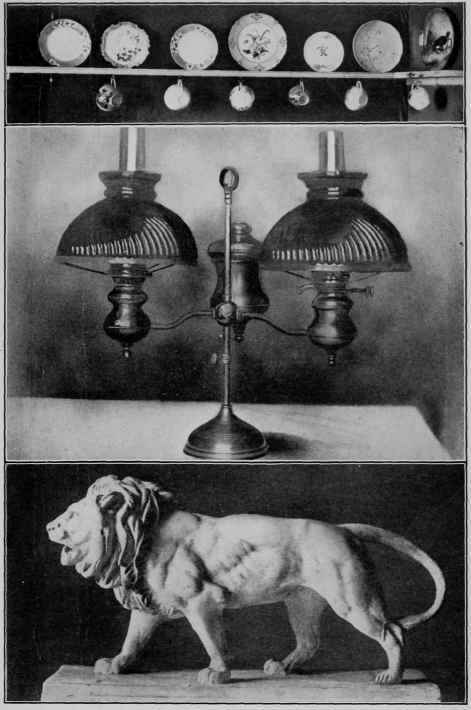
A SHELF WITH CUP-HOOKS UNDERNEATH.
A DOUBLE STUDENT LAMP IN BRASS. BARYE'S LION IN PLASTER.
In houses where the lamps are carried from one room to another it is wise to buy those of metal with handles on one or both sides.
The larger and handsomer lamps are made with the oil tank a separate part that may be removed for filling without carrying out the base. Drawing room and parlour lamps are in this way saved the risks of a trip into the kitchen department.
The lighting by candles and lamps alone throughout the entire house is made a hobby in some homes even when modern improvements are available. The result is always pleasant and restful, but entails a good deal of care and some little expense.
For the evening meal, afternoon teas in winter and general bedroom use the candle will always be in vogue. For the dining table candles should have pretty shades to harmonise with the flower decorations, and. to prevent accident from the blowing of the flame, the shades may be made up over a non-combustible lining. The shape of candle shades does not change from season to season, but there are novel ways for decoration and some new materials used from time to time. Some shades are made of accordion-plaited silk or paper; others are of tissue paper that is crinkled; some are of white water-colour paper painted with buds of flowers; or vellum is bordered in gold paint; some are formed with beads and finished with a fringe, and a thin openwork of metal is lined with a coloured silk.
The bedroom candle depends upon the style of its holder for giving interest to the smaller items of furnishing in this place. The tin candlesticks painted in an enamel colour, and those of coloured china are the least expensive for rooms of a cottage. Hand-painted work may be applied to fine white china to carry some idea that appears in the other decorations in the room. Brass candlesticks, either new or old, if of good design, can never be outdone in popularity. Silver candlesticks, either separate or as a candelabra, have a special affinity for the dining room, where they show to advantage among the accoutrements of the sideboard. Tall candlesticks made of dull-finished mahogany are also used on the dining table to contrast with the silver and glass.
Russian candlesticks of hammered brass that stand four and five feet high are sometimes placed in a dark corner to give a mysterious half-light.
Lamps and candlesticks are in most homes of to-day but an auxiliary to the electric or gas lights, and the city or suburban house must have one or the other, perhaps both, before it is considered completely equipped. In the selection of chandeliers and electroliers attention should be paid to securing patterns that are simple and graceful in design. There is a limited choice in materials, but the pal terns are legion.
Chandeliers arc not necessary in bedrooms where side lights do better service The chandelier is often omitted, also, from the living room and library, and in the hall and dining room a hanging lantern takes its place. If a single side light docs not give enough illumination in any one position a double or triple light may be installed.
The fewer kinds of metal that are gathered into one room the better is the result; so, in choosing gas brackets and chandeliers the aim should be to bring them into relation with the interior hardware, andirons and fire-pieces that are already in place. Bright brass is covered with a lacquer that renders polishing unnecessary; a dull brass finish has the advantage of a softer, more refined appearance than the bright variety, except on the antique specimens that have reached a rich lustre through many years of polishing. Brackets and lanterns of black iron are often replaced by a brass foundation painted black, at a less cost than the wrought iron.
Continue to:


My Books

