


XIII. The Veranda
Description
This section is from the book "Home Furnishing, Practical And Artistic", by Alice M. Kellogg. Also available from Amazon: Home Furnishings, Practical And Artistic.
XIII. The Veranda
A large degree of comfort in warm weather depends upon the piazza space that is available for fitting up as a sitting room. When the porch opens from a living room the interior furnishings may be used in either place with a few extra pieces for the especial requirements of one or the other.
The ideal veranda is seldom planned from the beginning, but its attractiveness develops as it meets the needs of the household.
The porch, in its relation to the house, has undergone a perceptible change in the past few years. Incorporated as it formerly was with the front entrance to the house the piazza lacked the element of privacy. In the newer architecture this need is recognised by placing the outdoor sitting place as far removed as possible from the main entranceway, to the gain of seclusion and freedom from interruptions.
A consideration of the piazza and its possibilities often reveals some fundamental mistake in its shape, size or location. An instance in which a simple remedy was applied for one of these errors was the changing of the entrance steps from one side (where they were close upon a neighbour's premises) to the opposite end. In another house a veranda that stretched straight across the front of the building in an uninteresting way was improved by carrying it around on one side and throwing out the angle in circular shape. To still another piazza extra space was added to the floor, which had been unpleasantly cramped, and an awning was put up for occasional use.
Structural defects may not always be possible to overcome, but they will be rendered less obtrusive by a careful selection of furnishings and some ingenuity displayed in arrangement. The long lines so commonly seen in the porches of suburban homes may be made much less conspicuous if they are broken up by cross lines.
The latter may be effected with the floor coverings or furniture or other movable furnishings. The outlines of the floor may be followed in selecting rugs, and the general proportions observed in choosing the furniture.
An uncovered floor is not at all undesirable for the veranda in warm weather, but if rugs are adopted they should be appropriate to the place. The cotton or jute rugs in dark colourings are inexpensive but not very durable. The East Indian mats in mixed patterns of dull red, ecru and black are cool-looking but unstable in colour. The grass rugs in plain red with a green border, or plain green with a red border are inexpensive and suited to the out-door scheme. Navajo blankets are of the most lasting value, as the sun or rain will not spoil their dyes. The imported dhurrie rugs are striking in design and colour, but not lasting. Their designs bear a close resemblance to the Navajos.
The right placing of chairs and tables is an item that is nearly as important as their good selection. As the veranda is so frequently a stopping-place between trips out-of-doors and within, it is wise to provide a comfortable chair and a low table near the entrance where one may rest and lay aside gloves, hat or parasol.
In the choice of the furniture the first thought is naturally to provide only such pieces as will endure the changes of weather; but so little variety is possible in weather-proof wood that it is more expedient to depend on two sets of chairs, for use in fair and changeable weather, the set for the latter light and quickly moved.
No prettier examples of porch furniture can be found than those made in our native willow by hand, in numberless patterns and sizes. By covering the willow with a varnish stain it can be brought into any colour scheme, and the seats and backs cushioned with plain or figured materials offer a further means for introducing artistic effects. Glazed chintzes and hand-printed linens are the newest materials for the coverings when designs are in order, and crinkled taffetas and rough-woven linens for plain colours.
In providing seats for the veranda the list will not be complete unless hammocks, chairs, footstools, benches and floor cushions are included.
Rustic chairs and seats have been for many years a pretence for comfort, and not constructed for beauty; but a better type is seen in smooth unpeeled wood that is physically commendable and attractive in appearance. One advantage of this furniture is its proof against rain and storms.
The colonial table-settle, in its oblong or circular shape, has gravitated from the kitchen to the piazza, where it accomplishes a triple office as chair, table and chest. This article is manufactured now in different sizes to meet an increasing demand, from the single seat to others six or eight feet long. Two coats of out-door paint should be put over the unfinished wood if it is to be exposed to the weather.
A small stool or bench that may be transferred from one portion of the veranda to another may be found in bamboo, willow, wicker or in Turkish make in which wood and strips of cloth are combined.
Rockers with high backs are the most restful chairs for the porch, but a variety of styles should be chosen to suit different persons. A steamer chair, one of the East Indian lounging chairs, or a swinging seat may supplement the hammock and be fitted with cushions and pillows.
An uncovered piazza requires some especial chairs, like the tall beach variety, made in willow or wicker, to give protection from the sun and wind without depriving its occupant of the fresh air. A swinging seat with an awning attachment is also welcome on the open porch.
A novel kind of hammock has recently been originated through the revived interest in rag weaving. Strips of cotton cloth are woven with a warp of linen thread in the old rag carpet style, with a result comfort-giving, durable and pleasing. The hammock taking the place of a lounge needs a set of pillows varying in weight and size to suit different occupants.
Silks, velvets, tapestries and embroideries may be passed by in the search for hammock pillow covers, and inexpensive materials chosen from washable materials, dark cretonnes, or such dress goods as galatea or gingham. If a decorative touch is fancied, some all-over stencilling may be applied to burlap in the soft finish or homespun linens.
Floor cushions are to be remembered, and these may be covered with striped duck, denim, grass cloth or corduroy, and filled with moss or hair.
A roomy porch will allow, besides the usual arm chairs and rockers, a small swing chair for the children and a large swinging settle for the older ones in the family. A square drop-leaf table and an oval or round tip-table are convenient for serving emergency lunches or afternoon tea. A light table that may easily be transferred from one part of the veranda to another may be selected in willow, round, square or oblong, in the natural finish or stained any colour. A tea wagon, completely equipped with a tea service, is made, to be wheeled out from the dining room upon the porch, and the top is kept for the serving and pouring of tea. Another device for this place is a carrying tray of copper which holds the alcohol lamps and kettle, besides the sugar bowl, cream jug, and cups and saucers.
An inexpensive device for holding books and papers is a wide shelf that folds against the side of the house. This may be put up by anyone who is handy with tools, and painted to match the colour of the wood against which it rests.
The privacy of the veranda may be helped by growing vines on the open sides. While hardy growths are slowly making headway some of the annual vines may be depended upon for a quick shade. The Japanese screens and striped awnings of duck are further means of inclosing the porch. The former have proved so useful that they are now made in colours to suit the house instead of in the bright and aggressive yellow of the varnished rattan.
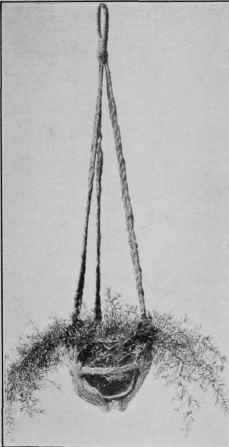
A HOLDER FOR FLOWERS, MADE OF RAFFIA AND POTTERY.
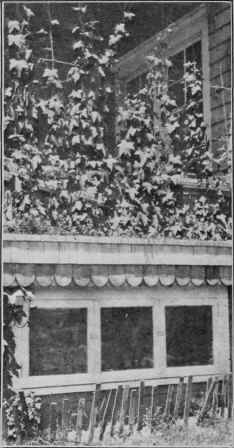
A SHINGLED PLANT BOX.
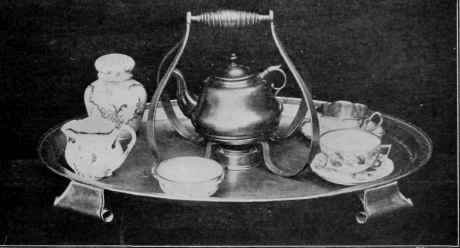
A CARRYING TEA TRAY FOR THE VERANDA.
Plants grouped along the outer edges of the piazza floor, or arranged in the corners or nooks, will bring the atmosphere of the garden within close range. Jars or holders of pottery may be used for the flower pots, or wooden boxes painted like the sides or floors of the piazza may be filled with plants and drooping vines.
Hanging baskets of porcelain for the veranda are made by the Japanese, and wall pockets and pot holders, suspended by strands of raffia, are the work of our own country people. Some special flower holders may be kept for the veranda in Spanish or Mexican jars and vases.
The piazza should have a thoroughly practical means of illumination on dark nights, with care paid to the entrance steps. If gas or electricity cannot be introduced in a substantial wrought iron lantern, a picturesque brass lantern to hold oil may be substituted. The better quality of paper lanterns made by the Japanese may always be adopted when festive occasions require a decorative feature.
No part of summer life is so delightful as that of having some of the meals out-of-doors. A porch that leads into the dining room makes this enjoyment one that exacts little care and permits frequent transits from the interior to an open-air feast. The decorations of the porch may be left to such utilitarian articles as lanterns, flower holders, awnings and screens, which contribute interest and charm that are not dependent on the purely ornamental.
Continue to:


My Books

