


XV. Coverings For The Floor
Description
This section is from the book "Home Furnishing, Practical And Artistic", by Alice M. Kellogg. Also available from Amazon: Home Furnishings, Practical And Artistic.
XV. Coverings For The Floor
The products for the covering of floors have never before been so interesting and varied. We have not had the creative force of a William Morris to direct our national accomplishments in this line, but we are keenly appreciative of the good things that exist in our own country, and ready to give cordial welcome to what other nations bring us. How to use so rich a variety is a study that appeals to everyone who takes up house furnishing from a serious point of view.
During the past thirty years a considerable change has been effected in America in the treatment and fitting of floors. This seems a short period in which to reckon, when the history of floor coverings dates from before the Christian era, even to the ancient days of Egyptian splendour. Prior to that time primitive ages had adopted the skins of wild beasts to make a comfortable foothold in their habitations. The Babylonians were renowned for their weaving of rugs and the ornaments tion they introduced. From them the art was passed on to the Persians and the peoples of India, and so through Asia and Eastern Europe and, after the Renaissance, into France and England.
To the Oriental, rug weaving has a meaning much deeper than that of a mere mercantile pursuit. It is intertwined with customs, traditions, legendary lore and mythology. In India some of the designs are handed down through generations of weavers. In Persia and Turkey the sacramental character of the rug is prominent, as it was originally made for places of worship or in honour of the visits of distinguished persons. Certain shapes and patterns are, even at the present day, reserved for use at prayer. They may be of any variety of weave or any combination of colour, but the design must show an arch, to represent the door of a mosque. Sometimes three medallions are added, one for the head of the worshipper, and one at each side for his hands.
Sometimes the kelim rug, when woven by a Turkish girl to show her future husband her ability in the national occupation, has a romantic association. Large rugs often employ an entire family, and very fine examples may cover many years of industry. The amount of work put into a single yard of fine weaving (notably the Persian) may be estimated by the number of stitches - a matter, perhaps, of from two to three hundred thousand.
The vegetable dyes used in Persia have made the products of that country famous for their rich gloss and strong wear. So carefully are these qualities guarded that an effort to substitute mineral dyes was forbidden by imperial edict.
The first really popular knowledge that our country had of the value of Oriental rugs was gained at the Centennial Exhibition of 1876. The leaven has been diffused and has increased, until a widespread interest in the history and manufacture of these rugs has resulted, with an eager, intelligent desire for their ownership. In selecting an Eastern rug the general classification should be kept in mind, with the appropriate use for each different make. Its possession being for lifelong service, an understanding of its best use and a know! edge of its origin should naturally follow. While it is impossible to memorise the bewildering list of Oriental names, many of which are coined by irresponsible dealers, a general classification is not difficult to keep in mind, under which the genuine makes are numbered. Outside of the rugs made in India, there are four important groups in the Orient: First, the Caucasian; second, Turkish; third, Persian; fourth, Turkoman.
In the first division the best known varieties are the Daghestan, Kabistan, Karabagh, Shir-van, Kazak, Guendjie and Soumak. In the second, the Anatolian, Ghiordes, Koula, Oushak, Ladik, Melas, and Sparta. In the third, Tabreez, Senna, Khurdistan, Kirman-shah, Sarakh, Saruch, Serabend, Kirman, Shir-az, Khorassan and Ferraghan. In the last, Bokhara, Afghan, Beloochistan and Khiva.
Besides the contribution to floor coverings from Eastern nations, France, Germany and Great Britain have high-class products of their own. The Aubusson rug, which was first made in 1669, in a town in France, has retained its hold for certain schemes of furnishing and decoration; it has a close likeness to a woollen tapestry, and is without nap and made with a needle. The Savonnerie is another manufacture of the French, but it is hand-tufted very close, with a deep, velvety nap. The Berlin hand-made rug and the Scotch chenille are modern styles that are made in special colourings and sizes upon order.
America may also take a distinctive position among rug weavers, from the primitive work of the Indians in the West. The Navajo race produces the best examples of rugs, and, it is said, learned it from the Pueblos. Perhaps the Navajos' prominence is Hue to the tact thai their settlements are the best adapted to the raising and grazing of extensive flocks of sheep and goats, from which the wool is obtained.
The simplicity of their craft is shown by their spindle, which is a slender stick thrust through the centre of a round disk. With this they work at their loom of two horizontal poles, beginning at the bottom and working upwards. Their native dyes of vegetable matter are supplemented by the ravellings of a red bayeta cloth. Sometimes the coloured Germantown yarn is used, but with a loss of archaic style.
The blaze of colour with which the Indians adorn themselves appears also in their rugs, as their primary use was a blanket or dress. The patterns vary from simple parallel lines to complex figures that picture, as do those of the Oriental weaver, the legends and mythology of their tribes.
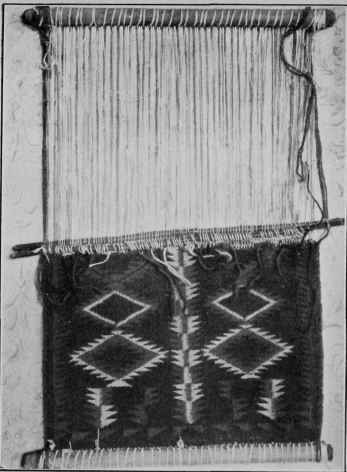
NAVAJO METHOD OF WEAVING.
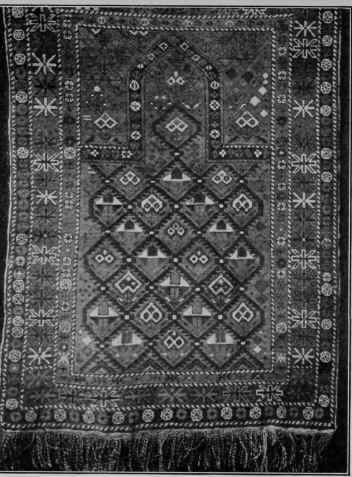
AN EASTERN PRAYER RUG.

COVERINGS FOR THE FLOOR.
The rag weaving of our early settlers has been revived in an artistic form by using strips of cloth in colours that amalgamate pleasantly, instead of the hit-or-miss colouring of odds and ends of stuff.
The Japanese jute and cotton rugs meet a temporary need when no very lasting quality is required. The Indian dhurrie rugs resemble the Navajo in design and in brilliancy of colour, but their colour effect is too highly keyed for city homes. This make is a favourite on yachts and in camp interiors.
A Scotch ingrain rug that may be used on either side is an excellent purchase for the home of moderate cost. Few colours are introduced and some are made with plain centres and a two-toned border, but the dyes are lasting and the wearing quality assured.
The designs in the Wilton rugs are copied from the Oriental, and in price and appearance these may be depended upon to give satisfaction. Mohair rugs of one colour give a pretty touch of colour to a room where the other floor coverings are very much mixed, and help to sustain a quiet decoration. Small white goatskin rugs may be sewed together for a bedside rug or for a child's room. A black or brown fur rug may be laid in front of a hearth or in a room with deep-coloured floor coverings.
When a floor is not shaped to carry a regu lar sized rug, a carpet may be made up as a rug and shaped to fit the room. A border may be sewed around the edges, or the plain breadths of carpet made up without a border. Some of the double or triple-width carpets may be used as rugs by having the ends bound with braid or finished with a buttonhole stitch.
A consideration of rugs for the house brings up the question of floors. Hard wood is now almost universally provided in the building of a new house; but where an old floor is impossible to use, the wood carpet may be adopted. This was originally made in France, and it can be procured in two different thicknesses, in squares or diagonal pieces that are nailed down over the old floors, the brads then being puttied over to match the colour of the wood. Wide borders of various coloured woods, or simply straight lines, of a darker colour than that of the body of the room, are used to finish the edge of the wood carpets.
When hard wood cannot be had for the floors, two methods are still open for covering them with carpets; namely, to select the carpet as a background, or to choose it from a decorative standpoint. In the first instance a rich appearance is secured by the velvet carpet in wide widths without seams. Its substitute in cheaper goods is of woollen or cotton fillings, or a plain Chinese or Japanese matting.
Carpets that show a decided pattern should be carefully chosen to bring them into relation with the other furnishings. Their selection is an important point, as their expense is a considerable part of the entire outlay for the room.
Printed oilcloths for the kitchen stand so little wear that inlaid linoleum or rubber tiling, although expensive, will repay by a continuous, satisfactory endurance.
Continue to:


My Books

