


XVI. Hangings For The Walls
Description
This section is from the book "Home Furnishing, Practical And Artistic", by Alice M. Kellogg. Also available from Amazon: Home Furnishings, Practical And Artistic.
XVI. Hangings For The Walls
Amateur attempts at selecting wall papers are usually disappointing. Taste and experience are imperative in this department of home furnishing and, in addition, the capacity to imagine effects before they are created.
There is but a slight historical thread to connect the rise and progress of wall coverings. Tapestry was employed in the Middle Ages, in castles and residences of the nobility, not only as a protection against the cold and dampness of the walls, but for decorative purposes. Wall paper began to be used in Europe, as a substitute for tapestry, about the middle of the sixteenth century. Clarence Cook ascribes its origin to the Dutch trade with China and Japan, and its earliest printing to Spain and Holland.
Modern wall decoration began with the Victorian era, and it was marked by a tremendous infusion of artistic power when William Morris, poet and designer, put his energies into the decoration of the home. A permanent place has been accorded the radical innovations made by him in the designing of wall papers. His patterns were drawn on a large scale, with a close repetition of the design, which was presented in clear, bold lines.
At the present time there is such close competition in England, France and Germany in the manufacture of wall paper that a distinctive line may not be drawn around any nation as producing the best. American wall papers are rich in colour, original in treatment and beautiful in design; and the same praise may be applied to the other countries named in this connection. The rapid progress made in this line of home decoration cannot be expressed by one year's examples. We must study from time to time at the Expositions the progressive achievements.
Wall papers of a high class are printed by hand, each colour necessitating a separate printing that must be dried before a second colour is used. Machine-printed papers may employ twelve or more colours during the process of production. A glance at the margin of an untrimmed roll of paper will show the number of colours by a series of dots. The cheapness of the domestic wall papers is owing to the pressure of competition. Pretty designs exist among the low-priced papers with almost the same frequency that they are found in the higher-priced varieties, but naturally a cheaper quality in the materials cannot give the same amount of wear as those of greater cost. Discrimination in the selection makes the temporary result good or bad whatever price is paid.
Modern walls have as specific needs of their own as did those of any other period. Their demands are met by a superabundant supply, typical of many of our manufacturing industries. As this embarrassment of riches covers nearly every phase of wall coverings, one must be prepared, when making a choice, with a definitely formed idea of the requirements of the room to be treated - a diagnosis, as it were, of its several parts, to which the wall hanging is to bring its completing touch: (1) The purpose or use of the room.
(2) The colour and kind of woodwork.
(3) The amount of light in the room.
(4) The colour that harmonises best with the floor coverings and furniture.
(5) The wall colours of adjacent rooms.
If the paper hanger is not available for estimating the amount of paper the walls carry, it is not difficult to measure personally the height, length and width of the room; to note, also, the number of doors and windows and if there is a mantel. From these items the proper quantity of paper can be gauged by the salesman at the store.
Yet with every thoughtful precaution, the quantity of novelties shown to the buyer may result in the purchase of just the wrong thing, so a wise economy is to buy a roll of one or two papers that appeal to suit the conditions the best and test them at home by natural and artificial light in the rooms which they are intended to decorate. By matching two strips of the paper the design will be brought out more satisfactorily than when one small sample is brought into the house.
Styles change more often in wall papers than in any other furnishings for the house. The manufactures of one year can rarely be found twelve months after. Prevailing modes for the walls, therefore, are impossible to follow very closely; in fact, this is not necessary if the aim is to have something artistic and not something merely fashionable.
If the walls of a room are destined to hold beautiful paintings, or the patterns elsewhere in the room make a plain wall desirable, the ingrain and pulp tints can be drawn upon.
Plain papers are always procurable, and they merit a careful hanging to show their good effect.
Burlap, buckram and crash are sold by the yard and make a more expensive plain wall covering than a paper, but in some places and for certain conditions the extra outlay is worth while. For instance, in a hall in which there is much passing or carrying of furniture a paper will need frequent renewal where a burlap would show more endurance. As some of the burlaps fade when exposed to the sun, a preparation has been put upon the market for renewing the colour.
Next to the plain effect reached by the papers mentioned there are handsome English and German papers printed in two tones that dress the wall unobtrusively and set off antique furniture and tapestry. The choice of colour in the two-tones may be a repetition of some article already in the room - fireplace tiling, door hanging, window draperies, or some predominating note in the floor coverings.
Tapestry papers, with mixtures of greens and blues, have an important mission in connecting woodwork and furniture of alien colours.
Usually dark in colouring and heavily patterned, these papers Look their best when associated with dark. rich woodwork.
Silk finished papers are now made in re-strained designs in two tones of one colour, two colours exquisitely blended, or a colour printed over in cream-white. When silk, velvet, damask, jute, wool tapestries, linen and other textile fabrics are hung on the walls of handsomely appointed rooms they are sewed together in lengths and tacked to a light moulding that is fitted against the wall. Often a lining of canton flannel is added.
In the treatment of ceilings and borders there is often great lack of taste and judgment. The English plan of leaving the ceiling, un-papered, in a light cream tone, is a good rule to follow, making exceptions only when some special circumstance calls for them. A high ceiling may receive the plaster relief work that is made on both sides of the Atlantic, when the spaces are too plain and bare to be left undecorated.
When a ceiling is not in order for plain tinting a cream-white or buff-white paper may be put on without lapping the seams and the effect will be almost equal to a tint. A lining linen or burlap may be pasted on a ceiling that is not perfectly smooth and then treated to a coat of kalsomine.
A coved ceiling requires the ceiling tint or paper to be brought down over the curve to a point where a wooden picture moulding may be attached in an even line entirely around the room.
A sloping or uneven ceiling makes a picture moulding impracticable. Away to treat a room of this kind that is both novel and pretty, is to cover the ceiling and side walls with one paper, using no border, frieze, ceiling tint or picture moulding. A paper for such use must be light in tone and with an all-over design.
The room with a low ceiling should never be given a border at the cornice. The paper must be carried from the floor until it joins the ceiling, and a narrow picture moulding used as a finish. Low ceilings generally characterise small rooms, and these, if properly treated, may be made exceedingly cosy with the right papers upon the walls. Here is the opportunity for striped papers to be used to advantage, especially in two tones or with little contrast in colour, or, as in bedroom papers, stripes printed over with flowers.
Borders for wall papers are found in many styles. The domestic ingrains have some showy styles, too brilliant in colour to be satisfactory for quiet effects. The English manufacturers present, for the same kind of paper, some delightful floral and poster effects that, in the right situation, give character to the plain wall.
A room with a ceiling over nine feet may need a border, yet one may not be found among the regular line. In this event a patterned paper, that accords with the side wall, may be cut into strips to make a border of the desired width.
Sanitary printed papers find more than one place in the home - in the nursery, the bathroom, the housemaids' rooms, pantries and passageways - wherever a surface may need at times to be sponged off. A light weight oilcloth, in glazed and dull finishes, with floral or geometrical patterns, may be pasted on kitchen walls, and a new kind of burlap that has washable qualities is adapted to vestibule use.
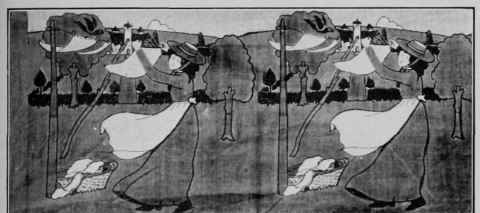
A BORDER FOR THE NURSERY.
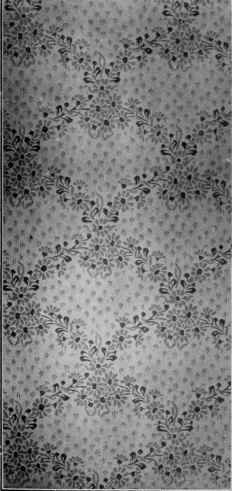
A PATTERN SUITED TO SLOPING WALLS.
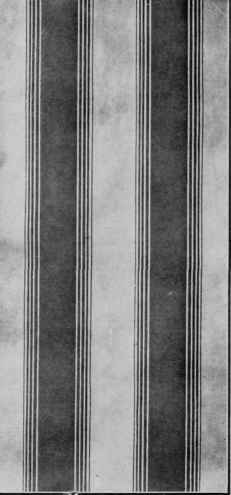
A STRIPED PAPER FOR A ROOM WITH LOW CEILING.
Picture mouldings are sold in strips of twelve feet at the wall paper stores in white enamel, oak, cherry and mahogany finishes. If the introduction of a dark wood to match the woodwork (the usual rule in selecting a moulding) makes too decided a line against a light paper, an unfinished wood may be put up and tinted like the paper.
Continue to:


My Books

