


Invisible Indication Of Preceding Vowels
Description
This section is from the book "Haven's Complete Manual Of Practical Phonography", by Curtis Haven.
Invisible Indication Of Preceding Vowels
In one of the paragraphs of Lesson III (Final List Of Visible Letters), the necessity for economy in word outline is incidently referred to, the word lass being used in illustration. By reference to the paragraph in question, it will be seen that the student is directed to spell lass and kindred words that end in double S, with a single S, thus: 1-a-s, lass. This exercise of economy in the use of the consonants is still more essential in words of more than one syllable, the young phonographer having most need for caution in those words in which the same consonants occur together in the ordinary spelling, as // in illiberal, rr in irregular, etc., etc. Young phonograph-ers are very prone to write illiberal with two commencing phonographic L's, when one commencing L is sufficient - illiberal, irregular, immoral and kindred words being divided into phonographic sound syllables, thus: short-i and li-brel for illiberal; short-i and re-glar for irregular; short-i and mrl for immoral. In other words,there are exactly the same consonant sounds in immoral and such words as there are in moral, etc. -that is, m-r-1 - the only difference being the commencing short-i; therefore moral and immoral should have the same consonant outline in shorthand, illiberal the same consonant outline as liberal, etc., etc.; the distinction between them being made by placing the word commencing with the short-i above the line of writing, as in signs 105, 107 and 109 in Exercise, the words moral, regular and liberal being placed on the line of writing, independent of their vowel sounds, they being words not needing invisible vowel indication, but needing to be in easiest position.
This brings us to the subject introduced by the heading to this portion of the lesson - the Invisible Indication of Preceding Vowels - the preceding vowel, in the case of such words as immoral, irregular, etc., being indicated by placing the outline in the first position, above the line. This is for one class of words having a commencing vowel. Another class, whose commencing vowel is followed by the sound of S, we indicate that commencing vowel by writing the long-S, as in sign 22, in Lesson III (Final List Of Visible Letters). If the commencing vowel should be immediately followed by the sound of L, we can indicate that preceding vowel by writing L downwards, as in signs 112, 114, 115, in this Exercise, as could also be done in the case of sign 107, if the student prefers, though in sign 107 it is not necessary, for the rule for // applies there. The writing of L downwards to indicate a vowel preceding it, applies also to syllables which are not the first syllables of a word. For instance, the syllable el of fuel, contains a vowel preceding the letter L of el, and therefore the L in that outline is written downwards. Sign 111 in this Exercise. Wherever a vowel follows L, write L upwards, as in signs no and 113. A vowel preceding S is indicated, as explained in Lesson III, by writing the S of the Invisible Alphabet, as in the word ask, sign 22 in Lesson III (Final List Of Visible Letters), above refered to, and as in signs 66 and 67 of this lesson.
Occasionally, a commencing vowel may be indicated by what is known as the fourth position - i, e., writing the first consonant of the word in question just under and touching the line of writing, as in signs 119 and 120. This position represents any commencing vowel, it being used only when the character of the vowel itself is not important, the writer merely needing to know that there is a preceding vowel to be able to read the outline. It is best not to use this plan excepting where the word has also a conspicuous third-place vowel elsewhere in its sound. The author does not particularly commend this fourth position plan; and, in fact, rather than hesitate between rules, the author would remind students that they can always use visible vowels to words commencing with a vowel, when they so desire, and it is often quite as convenient, as in signs 116, 117 and 118, though there are many occasions where the consonant outline alone is so plain that a beginning vowel does not need indication, as in such words as admission and attention, signs 121 and 122.
This matter of indicating an invisible beginning vowel is, after all, one which students of all methods of phonography must regulate for themselves. Some will find nearly all outlines perfectly legible without indicating invisible preceding vowels, while others who do not possess quite as good a memory of sight may need to make such indications frequently. Above rules, however, apply to all cases.
Exercise VII
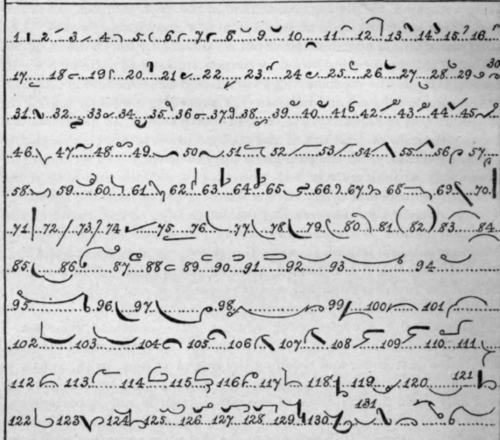
Key VII.
1, Date; 2, write; 3, rate; 4, vote; 5, that; 6, late; 7, Lord; 8, night; 9, need; to, mud; 11, might; 12, mighty; 13, bright; 14, bind; 15, cheered; 16, child; 17, cloud; 18, court; 19, told; 20, dread; 21, ward; 22, hurt; 23, yield; 24, wont; 25, flight; 26, fright; 27, found; 28, find; 29, notes; 30, mates; 31, braved; 32, grooved; 33, sort; 34, sound; 35, sprite; 36, sacred; 37, strained; 38, surround; 39, sent; 40, send; 41, slight; 42, receive; 43, received; 44, better; 45, mattress; 46, pullet; 47, midnight; 48, sentiment; 49, named; 50, maiden; 51, clothed; 52, rock; 53, rocked; 54, rib; 55, ribbed; 56, love; 57, loved; 58, knowest; 59, nicest; 60, fitted; 61, portrait; 62, titled; 63, derived; 64, deserved; 65, engraved; 66, assort; 67, assortment; 68, captivate; 69, bolder; 70, debtor; 71, diety; 72, chatter; 73, charter; 74, order; 75, culture; 76, fitter; 77, father; 78, farther; 79, falter; 80, verdure; 81, thither; 82, zither; 83, meter; 84, mother; 85, furniture; 86, wilderness; 87, sweeter; 88, water; 89, weather; 90, whether; 91, whether their; 92, enter; 93, enter their house; 94, center; 95, center their ideas; 96, further; 97, further their laws; 98, surrender their homes; 99, jumper: 100, hamper; 101, lumber; 102, tinker; 103, finger; 104, moral; 105. immoral; 106, liberal; 107, illiberal; 108, regular; 109, irregular; no. sickly; 111, fuel; 112, alum; 113, likely; 114, elective; 115, elocutionist; 116, else; 117, item; 118, Edmund; 119, answer; 120, another; 121, admission;` 122, attention; 123, ablution; 124, intimation; 125, intention; 126, indicates; 127, indication; 128, indicated; 129, undivided; 130, injunction; 131, No brave man employs slander.
Continue to:


My Books

