


The Beginning Hooks. Continued
Description
This section is from the book "Haven's Complete Manual Of Practical Phonography", by Curtis Haven.
The Beginning Hooks. Continued
The student should particularly bear in mind that, although, in writing these Per and Pel series of double consonants, they are commenced at the hooks, yet, in reading them, the R or L hook, as the case may be, is read after the main consonant; therefore, in reading Shel, the second syllable in facial, sign 53, the full sized consonant Ish is read before the hook L, and the hook L last; thus, fa-shel; not fa-lish.
Below is given a table of the double consonants:
Rer Rmer Ker Ger Per Ber Ter Der Cher Jer
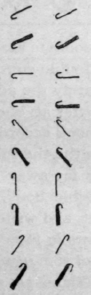
Bel
Rmel
Kel
Gel
Pel
Bel
Tel
Del
Chel
Jel
Mer Ner Per Ver Ther Eser Sher Ler
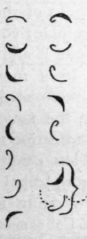
Mel
Nel
Tel
Vel
Thel
Shel
Triple and Quadruple Consonants. - The time-saving principle of double consonants has just been explained; but there are two still greater consonant combinations, known as triple and quadruple series.
The triple series is of two kinds - the Pler and Prel series and the Sper and Spel series, both of which are illustrated at top of next page:
Rler
Rmler
Kler
Gler
Pier
Bler
Tler
Dler
Chler
Jler
Fler
Vler
Thler
Shler
Mler
Nler

Rrel
Rmrel
Krel
Grel
Prel
Brel
Trel
Drel
Chrel
Jrel
Erel
Vrel
Threl
Shrel
Mrel
Nrel
Srer
Srmer
Sker
Sger
Sper
Sber
Ster
Sder
Scher
5jer
Sfer
Sver
Sther
Ssher
Smer
Sner

Srel
Srmel
Skel
Sgel
Spel
Sbel
Stel
Sdel
Schel
Sjel
Sfel
Svel
Sthel
Sshel
Smel
Snel
The above Pler and Prel series of triple consonants are made by enlarging the hooks of the Per and Pel series of double consonants. See signs 23 to 32 inclusive in Exercise. This is merely the adding of both beginning hooks R and L on same side of the letter at one time. The written hook itself remains the R hook or L hook according to which side it is on, the other hook being read between the the full sized letter and the hook, the fact that the written hook is far away from the full sized letter, indicating the insertion of the invisible hook. Pronounce the full sized letter first, invisible consonant next, and written hook last.
The Sper and Spel series of triple consonants in foregoing plate is formed by converting into a circle the R hook of the straight letters of the Per and Pel series of double consonants (signs 55, 58 and 59 inclusive); by writing the S circle inside the L hook of the straight letters of the Per and Pel series of double consonants (signs 56, 57 and 60) and inside both the L and R hooks of the curved letters, Signs 63, 65 and 66 inclusive. Where curved letters are only shaded to add L or R, the circle S is added naturally, as in signs 61, 62 and 64.
Sper, Sjer, Sker, etc., (signs 55, 58 and 59), will not clash with Sp, Sj, Sk, etc.; because in Sper, Sjer, Sker, etc., the circle is written on the left and lower sides of the main consonant to add R, while in the latter, the circle S is on its natural side. Compare signs 55, 58 and 59 of this lesson with 29, 31 and 23 of Exercise to Lesson III (Final List Of Visible Letters).
The quadruple series of consonants, like the triple, are of two kinds, the Spier and Sprel series and the Sesper series.
The Spier and Sprel series are formed by adding a circle S inside the hook of the Pler and Prel series of double consonants. See signs 67 to 71 inclusive and the following diagram:
Srler
Srmler
Skier
3gler
Spier
Shier
Stler
Sdler
Schler
Sjler
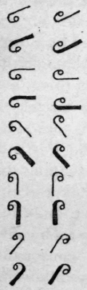
Srrel
Srmrel
Skrel
Sgrel
Sprel
Sbrel
Strel
Sdrel
Schrel
Sjrel
Smler Snler
Sfler Svler Sthler
Sshler
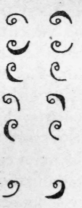
Smrel
Snrel
Sfrel
Svrel
Sthrel
Sshrel
In the cut below we illustrate the beginning hooks from double to quadruple series, so that the student may intelligently compare them:
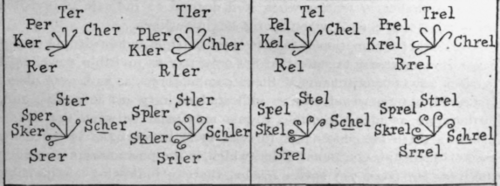
The Sesper series of quadruple consonants are formed by converting into a large sized circle the R hook of the straight letters of the Per series of double consonants. The circle is written twice the size of the circle S, and is really the Ses circle written upon the R hook side of the double consonants, as per diagram below:
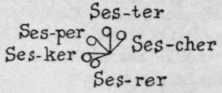
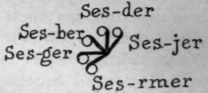
The Sesper circle cannot be added to the curved letters F, V, etc , and therefore, when used, will never be mistaken for Ses-p, Ses-t, etc., because, as with the preceding explanation of the difference between Sper and Sp, the double consonants Sesper, Sester, etc., are written on the reverse side of the P, T, etc., to that occupied by Sesp, etc. Sign 77.
In writing these triple and quadruple consonants, they are always commenced at the circle, when it accompanies them, and at the hook when the combinations have no commencing circle. In reading the latter class (the Pler and Prel series) the main consonant is read first, ler or rel last, as with the R and L hooks in the Per and Pel series of double consonants; but, in reading all combinations beginning with a circle (the Sper and Spel, Spier and Sprel series) the circle S or Ses is read first, the main consonants P, B, etc., next, and the hook or other letter of the combination last. This explanation refers only to consonants. Invisible vowels may intervene between any consonants, as in settle (sign 57), wherein an invisible vowel is indicated between the S and T of Stel, in which case S is read first, invisible vowel E next and Tel last. No invisible vowel, however, can be indicated preceding the circle S or Ses, because, as explained in Lesson III (Final List Of Visible Letters) , the long sign for S, as in the Visible Alphabet, is written when it is desired to indicate an invisible vowel preceding S or Z, when S or Z begin outlines.
In further explanation of the use of these triple and quadruple consonants, it is necessary to state that not only may an invisible vowel exist between any two consonants of these combinations, as with settle above instanced, but any vowel may be indicated, as in sprawl (sign 68), and, furthermore, as many invisible vowels may exist between the consonants as there are consonants to read them between, as instance the case of quadruple consonant Skier, which, in the position represented in the Exercise (sign 71) spells secular, thereby indicating an invisible vowel between the S and K, one between K and L, and one between L and R. It is best not to bother about vowels in this lesson. Learn the words without question, as shown in the Key, so long as the consonant combinations are well understood. The vowel sounds will be found to take care of themselves as you progress.
There are instances, as in signs 86 and 87, straggler and stickler, where the full form of hooks cannot be written, but signs thus slighted will be quite easily read by the student after becoming somewhat acquainted with them. Do not suppose, however, that sign 84 is similarly slighted, for the word descry is perfectly formed, thus: d-skr-i, desry.
Exercise V
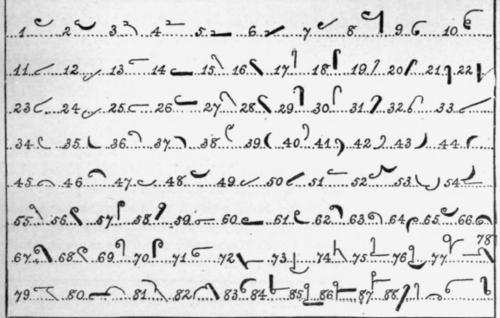
Key V.
1, Win; 2, wing; 3, wave; 4, week; 5, wag; 6, warm; 7, wire; 8, windy; 9, whale; 10, whistle; 11, rare; 12, rule; 13, cry; 14, goal; 15, pry; 16, blow; 17, try; 18, deal; 19, chair; 20, jail; 21, drew; 22, dowry; 23, roller; 24, rural; 25, collar; 26, girl; 27, pillar; 28, barrel; 29, dealer; 30, trial; 31, jailer; 32, Charles; 33, rarer; 34, fall; 35, fare; 36, veer; 37, vale; 38, Ethel; 39, their; 40, icer; 41, user; 42, share; 43, shawl; 44, lore; 45, more; 46, mill; 47, nail; 48, near; 49, rail; 50, armor; 51, kill; 52, shilling; 53, facial; 54, shellac; 55, spree; 56, sable; 57, settle; 58, sieger; 59, soaker; 60, saggle; 61, safer; 62, civil; 63, savor; 64, slur; 65, sinner; 66, small; 67, sabler; 68, sprawl; 69, settler; 70, sidereal; 71, secular; 72, buckler; 73, tunnel; 74, tippler; 75, treacle; 76, strainer; 77, sisterly; 78, cobbler; 79, corporal; 80, grammar; 81, viper; 82, labor; 83, leers; 84, descry; 85, straggle; 86, straggler; 87, stickler; 88, George tore May's silk dress.
Continue to:


My Books

