


Simple Attack And Defense - Standard Formations. Part 3
Description
This section is from the book "Football For Public And Player", by Herbert Reed. Also available from Amazon: Football for Public and Player.
Simple Attack And Defense - Standard Formations. Part 3
Since the restriction has been removed from the kick there is the threat of at least a short kick in every play, and since the necessary delay to make perfect the forward pass requires only that a member of the attacking backfield run back to a point five yards behind his own line and that "eligibles" move down the field, it may also be assumed that the forward pass threat also exists in every play. This means that the secondary defense will have to take plenty of room in which to work, thus being prepared to meet every possible form of attack.
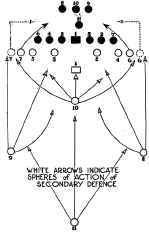
The loose center stations himself about a yard to two yards back of the line, the fullback, usually the heaviest of the backs, about four yards from the line, and the halfbacks from ten to twelve yards behind the line of scrimmage, and outside the ends of the defensive line. The quarterback, the last man in the defense, posts himself from 25 to 30 yards back of the scrimmage line. These relative positions are shown in the diagram, Fig. 1.
A defense so arranged is the nearest to perfection of anything I have seen against the normal attack. Defense against the kicking game and against shifts is treated at length in another chapter. It is necessary here only to emphasize the fact that the defensive players take position mainly with reference to the attack and with only moderate regard to each other. Such a system provides an elastic defense that should be able to meet any normal play and most abnormal ones, granting that the personnel is nearly equal to that of the attacking team.
Fig 1. NORMAL ATTACK AND DEFENCE.
Just one final word of objection based on some years of observation, to the waiting end. His post, in the very nature of the waiting defense, is farther from his tackle than in the case of the smashing end. He does not go to meet the play, and he even takes a circuitous route to his new position behind the opposing line. These moves are made without any idea of getting into immediate contact with the enemy. Should the play cut in between tackle and guard he will have played no part in the defense, whereas a smashing end, with his direct path to the runner, may be able to muss up a play that goes even directly into the center. He is a standing mark for any interference that may be thrown at him, and, since he has no initial momentum, may be carried out at times clear to the side line; worst of all, a play may be shot past so close to his own tackle that he cannot turn and dive into it in time to make any impression. I have seen some of these waiting ends standing like wooden images while the runner turned inside their posts, the attack not even wasting an interferer on them. Again, should his tackle by any chance show signs of weakening, and begin that kneeling defense that is so often the beginning of the end, the attack will be able to shoot plays right over the smothered tackle, the end helpless, in the meantime to get within tackling distance. The smashing end style has been adopted by many of the most capable coaches in the country, and has shown remarkable results under heavy fire. I believe that should schoolboy teams adopt this method their defensive play would improve at least fifty per cent.
It should be clearly understood that the theory is radically different from the old Pennsylvania method of years ago, when the ends were played close to the tackles and sent in to carry the runner out of bounds if possible. The newest method is a vast improvement on that system and a far more effective disorganizer of the attack.
Turning now to the simple formations that are given to the attacking team in October, and leaving a consideration of the kicking and forward passing games and the defense against them to another chapter, I shall begin with the normal formation shown in Fig. 1, as effective to-day behind a balanced line as it ever was. Indeed, all the formations treated here are made behind the balanced line, although it should be noted that they are effective behind the shifts as well.
One advantage of the old, or normal formation, with the quarter directly behind the center, and the three backs in a row parallel to the line of scrimmage and about four yards back, or even less, is its supreme concentration, and its consequent ability to take advantage of quick openings in the line. In all the formations shown in the accompanying diagrams it is well to keep in mind one general rule, a rule sometimes disastrously violated by even the greatest of the university teams - that in dashes into the line from tackle to tackle, the ball should always pass through the hands of the quarterback, while in runs outside of tackle, and more especially outside of end, the direct pass from the center to the back may be employed, although there is danger in this. Aside from possible fumbling or bad passing, a disadvantage of the direct pass on any run save from a kick formation is that an end is obliged to come around behind the play to make it safe, and his value as an inter-ferer beyond the line of scrimmage is lost. This, of course, does not hold true when there is a back posted behind the man who is to receive the ball, as in the diamond formation, when the recovery of the ball on a fumble or a bad pass may with considerable safety be left to the backs themselves.
Since pushing and pulling the runner have been abolished the normal formation allows an interferer to jump through a quick opening, with the ball carrier practically on his back, and since so little start is required there is a fair chance to shoot both men clear behind the opposing line. The beginning of the play being so close to the line, there is less danger of the play being spoiled by a tackle crossing over from behind, and the ends are free to cut across and concentrate on the first man in the secondary defense. Or the man with the ball may be shot through alone, the other backs affording lateral protection, while such line men as are not actually engaged in making the opening, may disengage from their opponents and shoot through to smother the secondary; an end, or both ends going on down the field to spill the last man in the defense should the runner succeed in getting clear.
Continue to:


My Books

