


The Story Of Bees. Part 2
Description
This section is from the book "The Busy Little Honeybee", by Josephine Morse True. Also available from Amazon: The Busy Little Honeybee.
The Story Of Bees. Part 2
Before the entrance of the hive there are worker bees on guard against enemies. Still others sit in the doorway, just fanning their wings for hours at a time. The fanners are driving the stale air from the hive and pumping fresh air into it.
When the worker bee, loaded with nectar and pollen, enters the hive, a crowd rushes up to see what she has brought. Like children with their mother's market basket, they all try to get a piece of the sweets. She pushes them aside and makes her way to the place where the nectar and pollen are to be stored. Here she sometimes rests for half an hour or so before unloading.
All through the hive are little six-sided rooms, side by side as well as on top of each other. These rooms are called cells, and their walls are made of wax. The walls are so thin that three thousand of them would be no thicker than a penny candle.
The wax that the bees use to build their cells oozes out of the under side of their bodies. As a flat piece of wax comes out, the worker bee tucks it under her chin, just like a napkin. There the wax stays soft. When the bee passes an unfinished cell, she places the piece of wax on it, smooths it, and polishes it. Then away she goes, dancing happily. Bees always seem to dance at their work.
The cells at the bottom of the hive form the nursery. Some of them are used as cradles for the young. In some, little bee eggs are hatching. In others, the Queen Bee may even now be laying eggs that will grow into more Queen Bees, workers and lazy drones.
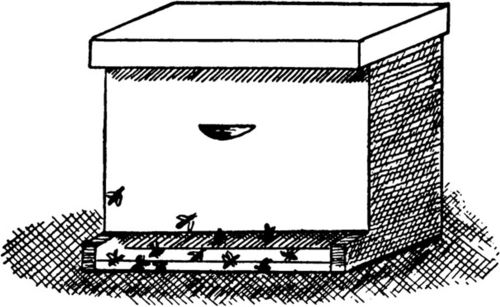
There are Worker Bees on Guard against Enemies.
The honey cells are higher in the hive. Here the worker bees are packing the honey and pollen that they will use for food during the winter when the flowers are gone and the flow of nectar stops. Here perhaps are the drones - fat hairy fellows - feeding at a day long dinner.
The worker, the Queen and the drone bees all look a little different from one another because all do different things within the hive. The worker and Queen are females; the drone is a male.
The worker is about half an inch long. She has six legs and two pairs of wings. On her flat head are two feelers, and she uses them sometimes as we use our fingers when we are feeling our way in the dark. At her back, just where a tail might be, is a stinger. When she stings someone, the stinger is tom from her body and she dies. But she loves her hive and her Queen so much that if necessary she is willing to die protecting them.


The worker bee is often in danger, because she flies so far from home. Her stinger helps to frighten away enemies. But she also has marvelous eyes to warn her when enemies are near. The two eyes that stick out on the sides of her head are large and have many sides like diamonds. On the top of her head are three small eyes, but no one knows whether she can see with these eyes or not. All bees have many hairs on their bodies, and the worker bee makes good use of hers. As she speeds from one flower to another, the pollen clings to these hairs. When she has enough, she rolls the pollen into a ball on one of her legs and is ready to carry it home for food.
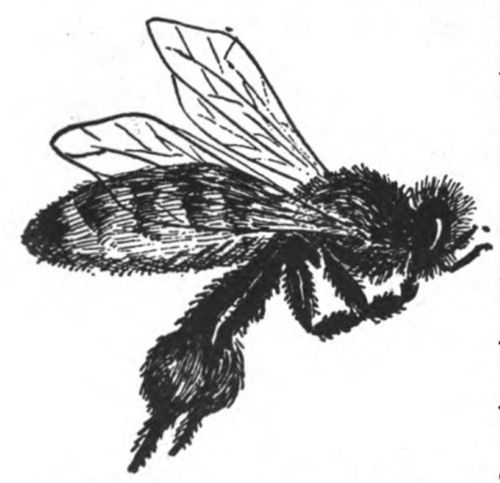
She Rolls the Pollen into a Ball on her Leg.
The drone is larger and fatter and hairier than the worker, but he has no stinger. The Queen Bee is the largest and longest of all. Her abdomen is especially large because the many eggs she lays each day are stored there. Like the worker, she has a stinger, but her hairs are short and thin.
All day long, as the Queen lays her eggs, there are worker bees attending her. They clean her and they feed her, because she doesn't leave the hive to find her own food. They even chew her food for her, because she must have so much food to make eggs that she needs help to digest it. It is not strange at all to see a Queen bee stick her tongue into a worker's mouth and drink the food the worker has been chewing for her.
As the Queen lays her eggs in cell after cell, the worker bees follow to make sure that the eggs are warm and safe. In each cell they have placed food so that when the egg hatches, the baby bee will have something to eat. Then they close the cell with wax and let the egg lie there until it hatches.
After a while out comes a little live thing that looks like a worm. This is called a larva. The larva eats all it can and falls asleep in a sort of shell that has grown around its body. While it sleeps it grows. And while it grows it changes. At last when it awakens, the worm robe falls off and there is a beautiful young bee. She rubs her nose and brushes her hair and begins to look for her first breakfast.
Eggs that are to be hatched into drones are put into larger cells. These cells contain more food and the drone larvae eat more than the worker bee larvae before they fall asleep in their little shells.
But the eggs that the workers nurse most carefully are the ones which will grow into Queens. When they decide to hatch a Queen, they build some very large cells. Then they take worker eggs and put them in these large cells. Around the inside of the cells the workers spread a special kind of food called royal jelly.
Continue to:


My Books

