


XXI. Window Seats And Cushion Covers
Description
This section is from the book "Home Furnishing, Practical And Artistic", by Alice M. Kellogg. Also available from Amazon: Home Furnishings, Practical And Artistic.
XXI. Window Seats And Cushion Covers
Window seats are not a modern invention. In Queen Elizabeth's time the wide, protective walls pierced by narrow windows often inclosed the built-in seat. In the architecture of later, more peaceful centuries the diminished thickness of the walls made the stationary seat unavailable. In its place the cabinet maker provided a window chair without a back and with handles instead of arms at the two ends. This type of chair is seen in reproductions of the old models, and occasionally an antique specimen is found.
A seat built below a recessed window is almost always justified by its pictorial effect even if it is not used to any great extent. The person of matter-of-fact tendencies is sometimes heard to object to this kind of seat because when sitting in it "one cannot look out of the window." On the other hand, the visual enjoyment of a room that is tastefully appointed exceeds that afforded by a commonplace exterior view, the former prolonging itself indefinitely through artificial lighting.
To incorporate the window scat successfully within the architectural lines of the house, it is necessary to realise the importance of this part of the interior fittings while the plans are in preparation. The remodelling of an old house sometimes makes the introduction of a window seat practicable.
Window seats, notwithstanding their popular appreciation, are rarely too much in evidence. One may call to mind single rooms where the window seat contributed to the attraction, but few houses are rendered distinctive throughout by this feature.
Window seats are disappointing when they are not properly located and when their construction is not rightly understood. A window seat in an entrance hall where no one sits and where it receives only casual attention is practically wasted. Formal rooms of the house make no especial claim upon this device, but in the living rooms it is a means of securing cosy, inviting-looking interiors. The best situation for the window seat must be a question for individual decision. The dining room has probably the most urgent claim when it is in much demand for afternoon or evening entertainment, and the picturesque quality of the window seat is most welcome among the conventional furnishings of this department of the house.
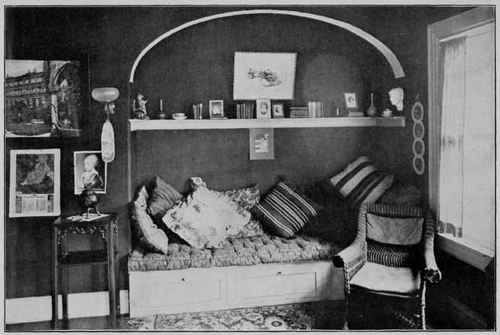
A CUSHIONED SEAT NEAR A WINDOW.
Brick houses with walls eighteen or more inches deep offer the simplest solution to the making of window seats, but with walls of ordinary thickness good effects may be made by projecting a casement window outside the running wall. Sometimes an uneven line of wall or a "jog" invites the introduction of a window seat, and the arrangement is made doubly satisfactory if it is inclosed like a box and made a storage place. In a bedroom a window seal of this variety supplements closet and bureau in a helpful way. Sometimes it is devoted to extra bedding, sometimes to sewing materials. In a living room it may always be utilised as a stowaway for articles that must be kept at hand but out of sight.
In the construction of the window the primary consideration is the height. With a cushion laid over the top of the seat the distance from the floor should be less than if it is left uncovered. In some rooms smooth, finished boards suit the conditions better than an upholstered cushion. A mattress for a window scat is usually three inches high. It may be made of hair if the best filling can be afforded, or cotton, felt or moss may be the filling at a less cost. If cushions for long seats are made in sections they will be more easily handled on cleaning days than if they are made up in one piece.
A covering for a seat cushion has a large share in making a window seat a harmonious part of the room. A plain material may be the choice and an ample variety can be found in durable materials. Corduroy is especially appropriate for such use. If a mixture of colours in a figure is preferred a cotton or wool tapestry may be secured. In using a striped material the effect is better if the stripes run into the window instead of along the front.
A seat built against or underneath a window is sometimes very desirable but unattainable. A simple substitute is a movable box with a lid that can be raised. A packing box of the right size may be lined for this purpose with wall paper and then the outside covered with cloth. Handles, a lock and hinges of good pattern will complete the usefulness of the box for safe keeping, and the top will make another seat in the room.
Pillows numbering seven are a comfortable allowance for a divan. "One for each day in the week," said a bright little woman who illustrated her remark by bringing her Sunday pillow most prominently to the fore on the first day of the week, the Monday pillow on the day following and so on through the seven days.
Before the selection of the cushion or pillow cover is made, the Oiling comes up with a question mark. When considering the different kinds offered at the stores for this use, down, feathers, moss, excelsior, silk floss, hair and cotton, it is well to understand the position which the cushion is to occupy. For a stiff back cushion hair or moss is better than feathers or down, but the latter are more suitable in some positions. A divan of the usual length may have three stiff pillows at the back measuring twenty-four inches each way. The covers for these should match, or nearly match, the cover of the divan. Soft pillows may be filed with down, and the best quality have an interlining to keep the material from pricking its way through. A pillow filled with goose feathers will be of more substance than the down, yet soft enough for comfort. The sizes of the down pillows are eighteen, twenty, twenty-two, twenty-four and twenty-six inches square. The smallest size, when not filled too tightly, makes a good head-rest for a chair with a high wooden back. This little pillow may either be fastened by tapes to the top rail of the chair or laid across and not fastened on. The twenty-two-inch pillow is the best for ordinary use.
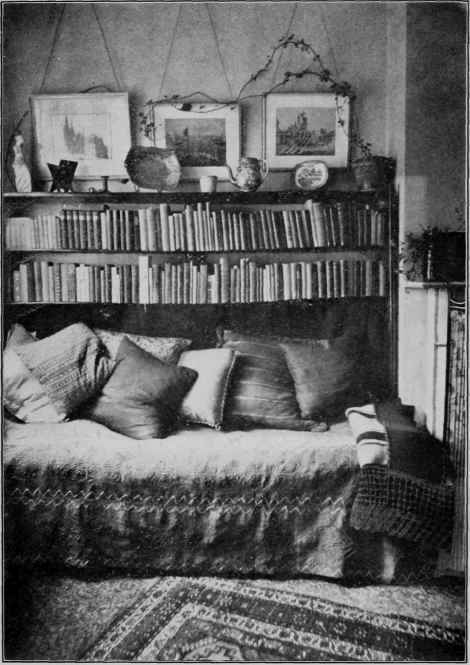
A CUSHION FOR EVERY DAY IN THE WEEK.
In looking up covers for the cushions the colour, texture and design must meet the price that is to be paid, and a further consideration to make the cover a complete satisfaction is its suitability to its environment. If the choice is made at a store some definite guide may be taken along in a bit of ribbon or paper that shows the colours already appearing on the divan. A hasty choice at a bargain table is certain to fail in making an artistic decoration in the home.
If the cover of the sofa is plain there is opportunity for introducing a variety of colours upon the pillows. A rainbow set of covers in red, orange, yellow, green, blue, indigo and violet was chosen as an outfit for a divan covered in a neutral tone, and in another home only the nasturtium colours were se-lected for a green lounge.
A sofa showing a decided figure on its covering looks better when its pillows are quiet in design and plain in colour, and the richer and more elegant the sofa cover the less conspicuous may be the pillows.
Pillow squares arc sold sometimes for only one side and when these squares are put together the seam may be hidden with a cord, gimp, fringe or braid. Skillful needlework is required to conceal the stitches in work of this kind. The best and the easiest way to make up a pillow cover is to cut the two sides the same size as the pillow and then sew up three of the sides and also two inches at either of the ends of the fourth side. The cord or gimp may be next sewed over the seams and the pillow slipped in when the fourth side is closed up and covered with the trimming.
When both sides of the pillow are alike a French seam may finish the edges on the right side without the addition of gimp or braid. This treatment is fully as satisfactory, if neatly done, as the former, and is one of the items for the home that may well be simplified.
In selecting a patterned material by the yard for a pillow, enough must be purchased to place the design in the centre. This, of course, does not apply to an all-over pattern, but is essential with stripes of varying widths or tapestry designs.
The covering for the sofa bears so close a relation to the covers for the pillows that one may never be planned without considering the other. The inexperienced housekeeper soon learns that the cost of upholstery work when well done makes durable materials the most economical in the end, and that quiet tones and closely-set patterns blend the best with other furnishings.
Lounges covered with heavy leather do not give the measure of comfort that is desired for resting hours, and a sofa less expensively constructed will give more pleasure.
If a plain divan is used a cover to lay over it may be chosen. The modern kelim rugs are appropriate for certain rooms when their colours are right with the surroundings. An tique rugs, however beautiful in colour, seem more in place on the floor than as furniture coverings.
Bagdad stripes sewed together to spread over a lounge have enjoyed so wide a popularity that they are now copied in cheap imitations. The plain one-colour Bagdads, orna-mented with a simple stitchery, have not yet become so well known as to be common.
Among the goods sold by the yard that are suitable to throw over a divan or lounge are the velours, linen and linen taffetas, reps and jutes. These are fifty inches wide and cover quite a range in texture and price.
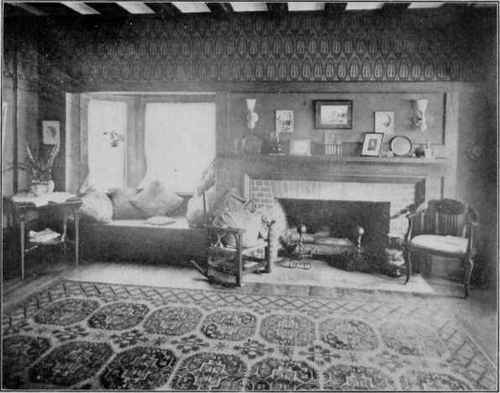
A WINDOW SEAT BUILT OUT FROM THE WALL.
Continue to:


My Books

