


Common Abbreviations. Continued
Description
This section is from the book "Haven's Complete Manual Of Practical Phonography", by Curtis Haven.
Common Abbreviations. Continued
Signs 58 and 59, in Exercise, show how the word-abbreviations help to distinguish between letters that are attached to them, those two outlines, although one begins with a letter of the alphabet, the letter I, and the other commences with the word sign for of, forming characters nearly alike, are rendered perfectly distinct by the fact that the word-abbreviations give them different positions, these word-abbreviations equally well distinguishing between halved characters and word-signs, even when there are no other means of distinction - which there generally are - halved outlines never clashing with a vowel character or a word-sign, as they are used for different purposes. .
The word whereas, as will be seen by sign 63, is formed by the juncture of the word-abbreviations for where and as. In the next compound word, shown by sign 64, elsewhere, the word where is out of position, but, being joined, is perfectly legible in that case. This leads us to state that the words else and less will sometimes clash unless the E of else is written, or some other means of indicating that beginning vowel is taken advantage of - for instance, in junctures where the vowel cannot be written, write less upward and else downward. This can only be shown in junctures. When else is written alone, else must have its vowel written.
In signs 77 to 80 inclusive, the circle-S is added within loops to indicate the addition of is, as or was.
The word seldom, on third line from the end of Exercise, is abbreviated by omitting the M. It is perfectly legible thus curtailed.
To signs 87 to 98 inclusive, the student should give special attention. In Lesson III (Final List Of Visible Letters), describing the use of the circle-S, which, in this lesson, represents is, his, as, has, or was, according to position, the student was instructed to always write such circle on the right-hand side of upright or slanting straight characters, and on the upper side of horizontal ones. In that same lesson the student was enjoined, when the circle-S was added to R or Arm, to consider those letters the same as the horizontal ones K and Gay, because they are written in the same direction-from left to right - the circle being thus attachable upon the upper sides of R or Arm, precisely as to K and Gay. This same rule will apply to the word-sign for the when the circle is joined to it, because the stroke the is written upwards from left to right, the same as K and R, and therefore takes all circles added to it on the upper side of the stroke, as in signs 87 to 89 and 96 to 98 inclusive. On the other hand, the stroke he, being written downwards, the circle-S is attachable to it on the same side as to the letter Chay, the circle being, therefore, according to rule before quoted, attachable on to the right-hand side of Chay or the stroke he, whether such circles begin, as in signs 90 to 92, or terminate he, as in signs 93 to 95. This arrangement - writing the stroke always downward for he and upward for the, and placing the circles on the upper left-hand side of the and right-hand side of he, will serve as a sure means of distinction between such outlines, both in reading and writing. The circle-S, representing is, as or was, may be written double length to add the word there or their, as in signs 74 to 76. These forms will not clash with is it, as it and was it, in word-abbreviation list, for those word-abbreviations are slanted, whereas signs 74 to 76 are horizontal.
Exercise IX
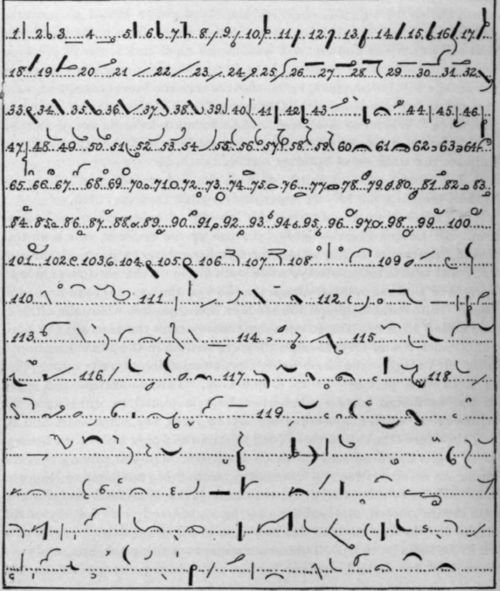
The word shall, in sign 111, will be noticed to have been written upwards. This is allowable where junctures are to be facilitated with letters or words, but when Ish has only hooks attached, and no other character added, Ish must be written downwards, as in sign 42 of Lesson V (The Beginning Hooks), and sign 49 of Lesson VI (Final Hooks), to show on which end the circle or hook is to be read.
Key IX.
1, It; 2, its; 3, come; 4, comes; 5, do; 6, does; 7, and do you; 8, charge; 9, charges; 10, discharge; 11, large; 12, larger; 13, largest; 14, advantage; 15, advantages; 16, advantageous; 17, disadvantage; 18, Jesus; 19, Jesus Christ; 20, yours; 21, are; 22, are there; 23, our; 24, ours; 25, hourly; 26, give; 27, gives; 28, give them; 29, common; 30, commonly; 31, commonest; 32, to be sure; 33,, is to be; 34, object; 35, objects; 36, objector; 37, objection; 38, objective; 39, taken; 40, taken up; 41, to-day; 42, to-day's; 43, Yours of to-day's mail received; 44, out; 45, outward; 46,outside; 47, outwit; 48, off; 49, often; 50, office; 51, facts; 52, wish; 53. wisher; 54, wish their; 55, think; 56, thinks; 57, and thinks his a; 58, I think; 59, of them; 60, improve; 61, improves; 62, where; 63, whereas; 64, elsewhere; 65, year; 66, years; 67, yearly; 68, is; 69, is his; 70, as; 71, as has; 72, was; 73, was as; 74, is there; 75, as there; 76, was there; 77, as there has; 78, is it as; 79, as it has; 80, was it as; 81, and is; 82, and as; 83, and was; 84, is an; 85, as an; 86, was an; 87, is the; 88, as the; 89, was the; 90, is he; 91, as he; 92, was he; 93, he is; 94, he has; 95, he was; 96, his is the; 97, as has the; 98, was as the; 99, is not; 100, is sent; 101, is seen; 102, is that; 103, that is; 104, has been; 105, as has been; 106, why there have; 107, whether there have; 108, His time is limited; 109, Has it your full authority? no, The patent is my invention; 111, At what hour shall I be on board? 112, That issue as given forth came out Tuesday last; 113, A select party of us will make the trip up-country; 114, Where is it the charges are to be found? 115, I am far from liking the form of his order; 116, Which offer was it the author first made you? 117, The value the thing brought was small-one dollar in a thousand; 118, If our plan ever matures as it should, we will owe many thanks to the little kingdom; 119, How long were you there with young Brown ? One year. Can he appreciate the importance of a use of that language ? Yes, I think he does. Does he use it often ? Yes, sir. Yet the others say they never heard him? They were seldom with him; we were usually together daily. He improved each day beyond my calculations. Any change, however hard, took but little time for him to master. To-day he will read four chapters, though to do from one to five an hour would take but little effort when he either wished to or has had much rest at home. I hope for still more important improvement.
Continue to:


My Books

