


The Story Of Bees. Part 4
Description
This section is from the book "The Busy Little Honeybee", by Josephine Morse True. Also available from Amazon: The Busy Little Honeybee.
The Story Of Bees. Part 4
The farmer who keeps the bees tries to prepare for the swarming time by putting empty hives in places where the bees can see them. Then they will not fly too far away.
The farmer knows, too, that if he can pick up the Queen Bee and place her in a new hive, all the others will rush after her, make her comfortable and begin building new cells or honeycombs again. The Queen will begin to lay new eggs. The workers start out for new honey. The old life in a new home has begun again.
There are other reasons for swarms.
There may be illness. The hive may be smelly. There may not be food nearby. Sometimes they just want to return to the old life in the wilderness. They want to live in the trees again as they did long ago.
Sometimes the farmer will try to prevent swarming by cutting the Queen's wings. He knows that the swarm will not go very far from the Queen. If the Queen cannot fly far away, the farmer will always be sure of capturing the swarm again.
But if the farmer takes care of his bees and gives them enough to eat, and a big enough hive, his bees will not run away from him.
Bees like comfortable homes, just as we do, and hardly ever move away without a good reason.
But even in a comfortable home, bees have troubles. In winter they have to keep the hive warm enough so that they will not freeze to death. Many times a farmer has come upon a cold hive. Before the entrance are the dead bees which have been carried out of the hive by the live bees within.
To keep warm in the winter time the bees come close together inside the hive. They move quickly around and rub against one another, moving their wings all the time. This keeps them warm, just as it keeps us warm to stand close to someone else.
Like us, bees have sicknesses. They get stomach aches and fly about slowly, and don't dance at their work.
And like men, bees have enemies. There are some bees who don't like to work for a living. And so they try to get into another hive to steal food.
When a robber bee comes near a hive, she goes very slowly at first. She circles about, and then suddenly darts into the hive. Now if she had gone into that hive as if she had always lived there, the other bees would never have noticed her. But a robber bee always acts like a robber. She is afraid because she is doing something wrong.
When the other bees notice the robber, they all rush at her. And off she flies at full speed to save her life.
But bees have worse enemies than robbers. In the south of the United States there is a kind of ant which attacks the beehives and destroys every bee there.
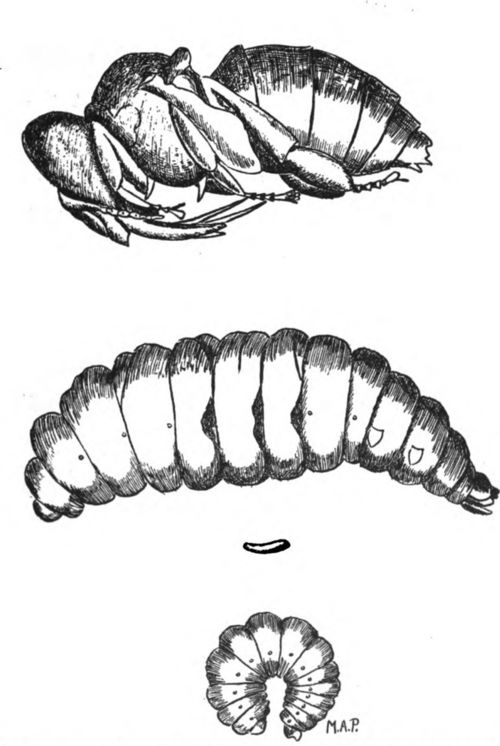
The Larva Falls Asleep in its Shell and Wakes up a Beautiful Young Bee.
At first these ants come out a few at a time. They steal a little honey here and a little honey there. The honey feeds the old ants and the young ones. After a while the young ones grow up, and there are enough ants to make an army. Then this ant army comes marching up to the hive in thousands.
There is a terrible battle. Many of the bees lie dead with wings and legs torn off and heads cut to pieces. Of course, a number of ants are killed in the battle too. But in the end the ants usually win. They climb into the hive and steal as much of the honey as they can carry.
Farmers take special care to protect their hives from these ants. They look for ant nests and pour boiling water over them.
There is one story that shows how bees get the better of some ants.
A few of these ants were beginning to rob a hive. But there were not enough ants to make a big war on the hive. And the bees could not kill them because of their hard shells. What did the bees do? They picked up every ant that tried to climb into the hive. Then they carried the ants across a stream, so that the ants could not cross the water to come back to the hive again.
That's how wise the honeybees are!
Of course there are other bees besides honeybees, and in their way they are just as wise and just as clever.
Like the honeybee, some are social. That means they live together in large numbers. Others live alone. These are called solitary.
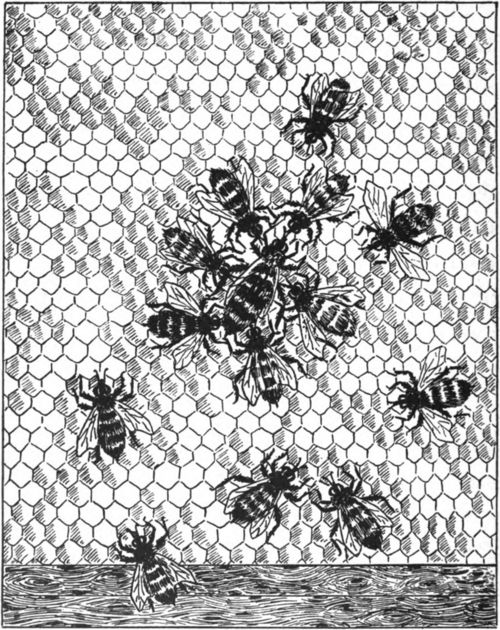
All Day Long there are Worker Bees Attending the Queen.
The miner bee is a solitary bee. She makes a hole in the ground, builds a nest there, and lays her eggs. Carpenter bees are very much like miner bees, but they bite into solid wood to make their nests. Sometimes they will make a long hole in a stump of wood. They lay an egg at the bottom of the hole and cover it. Then they lay another egg and cover it, and so on. The wonderful thing about this is that the last egg to be covered is always the first to hatch, making way for the one under it!
The solitary bees make up a little family of mother, father and a few babies.
Bumblebees are social bees. But they don't stick together as the honeybees do. At the end of the summer, the female bees leave the hive and find hiding places for the winter. The drones all freeze to death. In the spring the females come together and build a new hive again.
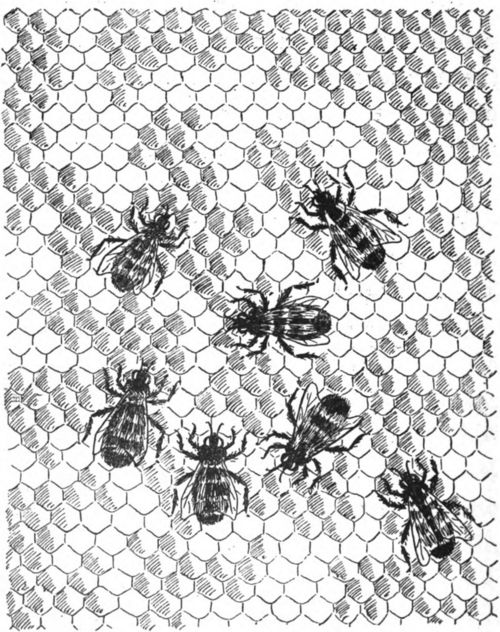
Drones Feeding at an All-day Dinner.
The honey of the bumblebee is not very good for us to eat, but bumblebees are very useful to the farmer. They help him grow a good clover crop.
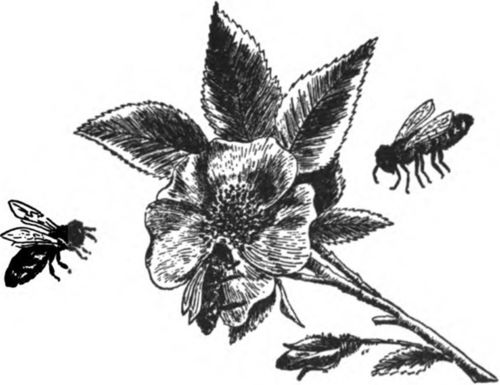
Bumblebees are the only bees with tongues long enough to get deep into the long-necked clover blossom. And as the bumblebees pass from clover to clover they carry the clover pollen from one blossom to another. Then the clover seeds get ripe and much clover grows from them. The farmer's cattle get fat and his ground gets rich and fertile. So even the bees that don't make honey for men can be of use in other ways.
The best way of learning about the bees is to go out to a farm, and watch them work. The farmer will give us something to cover our hands and face, so we won't get stung. After a while the bees will even come very close without stinging us.
We should never be afraid of a bee. She will not sting unless we try to hurt her or her hive. She is really a very friendly insect, as well as a very useful one.
Continue to:


My Books

