


Mantels And Inglenooks. Continued
Description
This section is from the book "Home Furnishing, Practical And Artistic", by Alice M. Kellogg. Also available from Amazon: Home Furnishings, Practical And Artistic.
Mantels And Inglenooks. Continued
The hearth stones may be of tiling or bricks, the bricks giving better service than a smooth, glazed tile.
The selection of wood for the mantel is sometimes a puzzle to the home builder. A good rule to observe is to bring mantel and woodwork into close relationship by choosing the same wood for each. With woodwork of cypress, pine or poplar in the natural finish oak is often adopted for the mantel.
The necessary fittings of the open fireplace are the set of fire-pieces, which includes tongs, shovel, poker and brush, and andirons or grate with a spark guard or fire screen. A brass fender helps to dress a fireplace that is used for burning wood and is really needed for a grate. The stationary grate has been abandoned in the newer houses for a basket or movable grate of iron. The simpler the design of this article the more it suits its utilitarian duty.
The old Franklin fireplace, made by the famous philosopher in 1742 and called by him "an open stove for the better warming of rooms," was a combination of open fire and stove, needing only a vent in the chimney to carry the pipe. Some of these Franklins have survived until the present century, and the idea has been revived in a portable open stove that may be placed against or into a fireplace for giving an open fire. This contrivance concentrates the heat more profitably than the real open fire.
Andirons, or fire dogs, as they are sometimes designated, are an interesting part of the fireplace equipment. From their prominent position they are the means of enhancing or destroying its aesthetic appearance. Their movable quality makes the andirons appeal more strongly to the occupants of rented houses than the stationary fittings. The careful buyer of andirons seeks for symmetrical shape and good material. In the two varieties of brass, the cast and the spun, the former, although the more expensive, will last longer. A lacquer finish on the bright brass will keep it for quite a period of time without any need of polishing. When the dull finish is preferred the lacquer is omitted. In homes where the time and attention cannot be given to keeping old brass in proper condition, a choice of the wrought iron is more practical. This may be plain in design, without fancy curves to catch the dust. The best iron is that wrought by hand, and is, of course, more costly than the cast iron.
The open fire must have a supply of fuel close at hand, and if coal is used a brass or copper scuttle may he added to the fire-pieces; or, with a wood fire, a willow basket Of a wooden chest may hold kindlings and to Each one of these details, small in itself, makes the fireplace satisfactory as a whole.
The mantel is a consideration by itself. In the cheaper grades of houses the fireplace is often fictitious and there is no opportunity for keeping a fire on the hearth or in a grate; the mantel with its side supports and tiling, however, gives a semblance of the real thing. The mantel shelf is then the point towards which the home maker may give her best attention.
The dressing of a mantel shelf is not an easy matter. Sometimes the effort of accomplishment is so apparent that it destroys the good effect, or there is an accumulation of unmeaning ornaments that is bewildering to the eye. Study and observation are needed in this part of the home furnishing. Of course, the uses of a room enter largely into the choice of articles for a mantel. The dining room is quite different in character from the sitting or living room. The parlour, or reception room, should have few objects on its mantel, and those of a rather formal style - something that is beautiful in itself without personal association, and that will give enjoyment to the visitor. Any amount of expense may be put into such ornaments, the smaller and more refined workmanship often costing the largest outlay.
A library mantel should receive a characteristic treatment. A bust of a favourite author in bronze or plaster may be given the place of honour in the centre, with some pieces of pottery or china of historical or artistic interest at either side.
The mantel of the living room may express the changing interests of the household in an unconventional arrangement of pictures and bric-a-brac. In mantel decorations for the dining room those that have some interesting association will bring them in for a share of table talk.
.83
HOME FURNISHING
Bedroom mantels are a perplexing mat to treat when they are clumsily built. A white marble mantel that is ugly in shape and unpleasantly cold-looking may be improved by painting it to match the colour of the wood-work. A glaring, smooth-tiled mantel may also be changed for the better by applying the Hat-finish brick paint. A very simple covering for a mantel may add to the daintiness of the furnishings. A wooden board is laid upon the shelf, first covered with a straight piece of cretonne and edged with a narrow-ruffle. The mantel of a bedroom is the persona] property of the owner of the room, and naturally takes on a more significant expression of individuality than in rooms used for other purposes. Here familiar and personal belongings may be displayed, and a glance at such a mantel will reveal the tastes of the occupant of the room more than an acquaintance of months or years.
The choice between hanging a mirror or picture over a mantel has sometimes to be made. For the former, the reception room or parlour seems the more appropriate position. The latter, if good in colour and composition, impresses itself in a homelike way when admitted to the wall of the living or sitting room.
Every room with a fireplace has possibilities for making a cosy inglenook. In expensive houses of the conventional type the fireplace, to be in keeping, must accord with the general use of both elegant materials and handsome designs, sometimes with a loss of the home element. Yet even in the more pretentious houses a skillful adjustment of furniture around the hearthstones will create an atmosphere of hospitality and cheer.
"The old-time ingle," says a British author, "had two main uses. The first was to protect a wide, open fire from cross drafts. The second was to afford sheltered seats near the fire, where the aged and feeble could rest, and where extra warmth was insured in inclement weather."
An inglenook may be originated in the plan of the house, and incorporated with the woodwork, or, it may be an afterthought and suited to its surroundings. By drawing a deep-seated lounge or settle near the fireplace and placing a screen at the back, an informal inglenook may be easily created not only for the older people of the family but for others who enjoy close contact with the heat.
An open fire so often invites meditation that a motto or thought is an appropriate decoration on or near the mantel. Sometimes the words arc lettered on the panel under the shelf or on the supports at the sides. Sometimes they appear in a frame like a picture, or they are painted on the wall surface. The idea may be developed in whatever way best suits the conditions and tastes of the household. A search for a fireside motto will pass many pleasant hours for the members of the family at home, or in libraries where there is a plentiful supply of books of quotations.
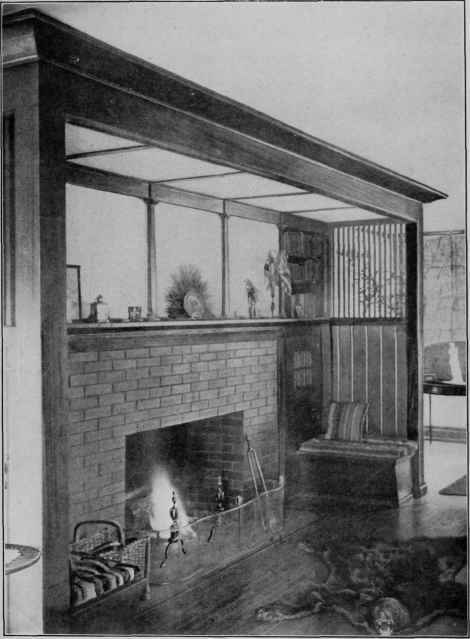
AN INGLENOOK DESIGNED FOR A LIVING ROOM.
Emerson, Shakespeare, and Stevenson will be found profitable fields for the hunter of mottoes for the fireplace, unless a preference is given to a selection from some author of lesser fame.
A motto lettered on the fireplace bricks in an entrance hall -
"Come, sitte besyde my hearthe, Tis wide for gentle companie," was well chosen for its position. In another home the following lines were burned into the woodwork of the mantel,
"Blow high, blow low, not all the snow, Can quench the hearth fire's ruddy glow."
Mottoes for the library are not difficult to find among the many tributes to literature. In an author's study the admonition, "Choose an author as thou wouldst a friend," was lettered in old English text and framed as an over-mantel decoration. Two lines from Longfellow's poems, -
"The love of reading, the sequestered nooks, And all the sweet serenity of books," were taken for the motto of a library in a country house.
A verse by Denham is less known than Longfellow's, but equally appropriate for the reading room:
"Books should to one of these four ends conduce, For wisdom, piety, delight or use."
Continue to:


My Books

